New Babylon
Core idea
A planetary network of elevated, endlessly reconfigurable sectors for a society of play.
Why it matters
The Situationist anti-capitalist counter-utopia of the nomadic city.
Description
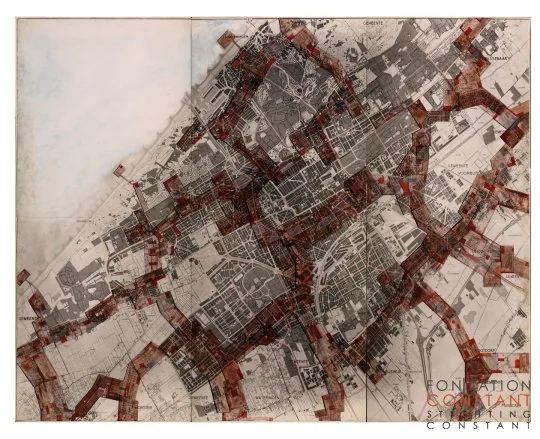
New Babylon is an unbuilt visionary project developed by the artist Constant Nieuwenhuys, an early member of the Situationist International, principally between 1959 and 1974. It imagines a worldwide network of vast elevated sectors raised above the ground on supports, linked into a continuous superstructure for a future society in which automation has abolished labour and land is held in common. Beneath lie automated factories and surface transport; above, the freed inhabitants roam a labyrinth of interior landscapes whose movable walls, floors and atmospheres they continually rearrange to construct situations for collective play. Conveyed through models, maps, paintings and collages, it depicts permanent mobility and creative reconstruction rather than a fixed plan.
Significance
New Babylon translated Situationist ideas of constructed situations and unitary urbanism into an architectural vision at planetary scale, proposing the city as an instrument of liberation for homo ludens rather than of production. Its rejection of fixed form, private property and functional zoning offered a radical critique of both capitalist and modernist urbanism. As an extended body of work spanning sculpture, drawing and theory, it remains a key reference for utopian and politically engaged design.
What became of it
Never built; existed as an evolving body of models, maps, paintings and texts (c. 1956-1974) and is regarded as a major work of post-war utopian art and Situationist urbanism.
Critique
As argued in scholarship on its utopian failure, New Babylon's premise of a fully automated, labour-free society of homo ludens rendered it a poetic critique of capitalist urbanism rather than an actionable plan.
What shaped it
- Cybernetics & systems theory (1948 onward)
- Marx & socialism (1848 / 1867)
- The Image of the City (1960)
- The City in History (1961)
- Utopian socialism (early 19th c.)
Plans it influenced
- Plug-in City (1964)
- Walking City (1964)
Sources
- https://en.wikipedia.org/wiki/New_Babylon_(Constant_Nieuwenhuys)
- https://stichtingconstant.nl/constant/periods/new-babylon-1956-1974