Nine Elms Linear Park
Core idea
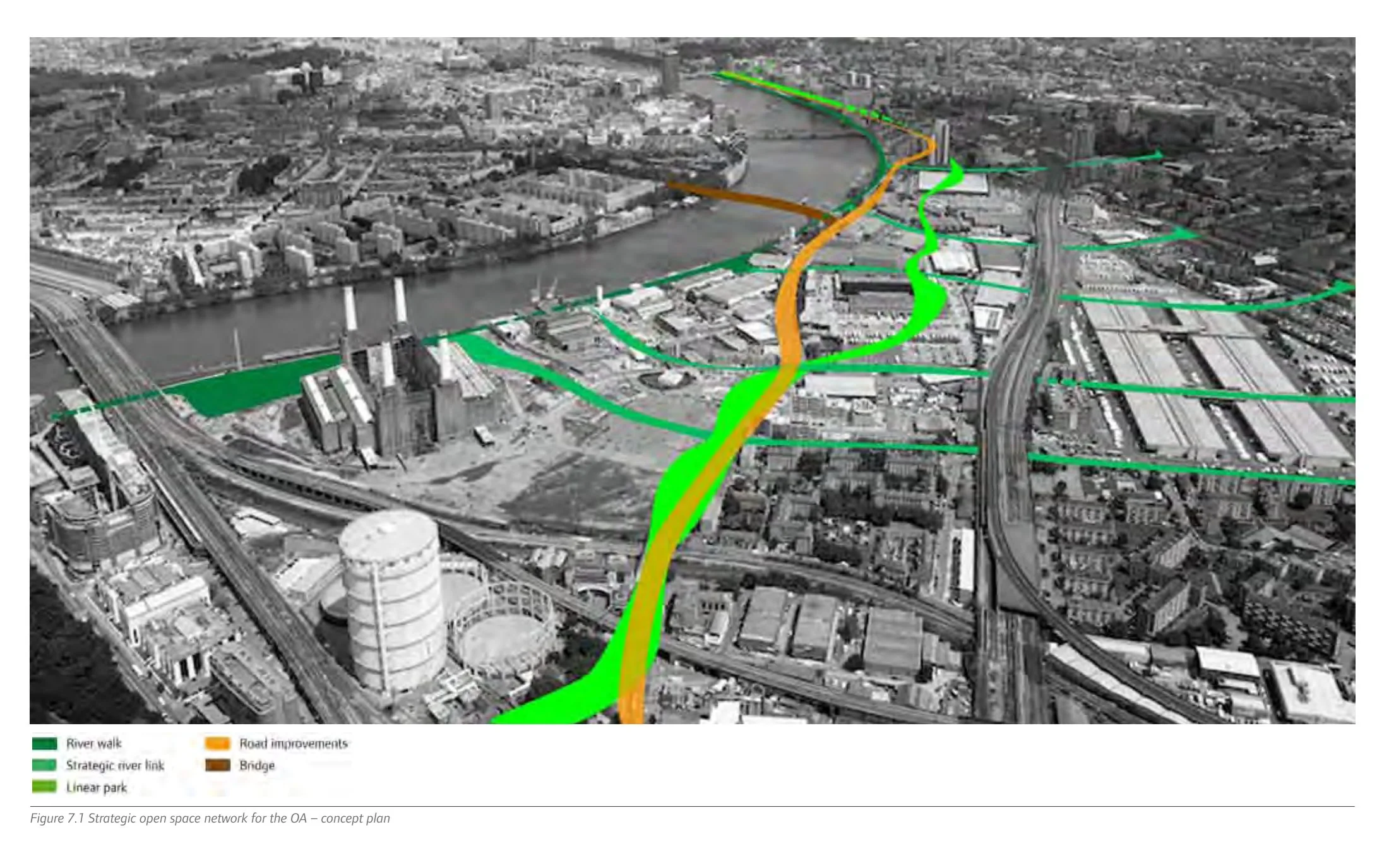
Green spine through VNEB
Why it matters
Public-realm armature for dense redevelopment
Description
Nine Elms Linear Park, planned from 2012 with LDA Design among the lead designers, is a green spine running through the Vauxhall Nine Elms Battersea opportunity area on London's south bank. Conceived alongside the area's intense redevelopment, including the new United States embassy and Battersea Power Station quarters, the park threads a continuous sequence of public spaces between dense new residential and commercial blocks. It provides the principal public-realm armature for one of Europe's largest regeneration zones.
Significance
The park illustrates the use of linear open space as connective infrastructure in developer-funded regeneration, securing public amenity piecemeal through planning obligations across multiple sites. Nine Elms as a whole has become a focal case in debates on hyper-dense, investment-driven London development, and the linear park is often examined as a test of whether fragmented delivery can yield coherent public space. It reflects the broader post-High Line enthusiasm for linear parks as regeneration devices.
What shaped it
- The linear park / greenway (1878 / 2009 revival)
- Landscape urbanism (Waldheim) (1997-2006)
- The public park (1843–1858)
- Life Between Buildings (1971)
Sources
- https://greenblue.com/gb/case-studies/nine-elms-linear-park-london/
- https://www.constructionnews.co.uk/sections/news/planning-permission-for-west-london-nine-elms-s