São Paulo Plano de Avenidas
Core idea
Radial-perimeter highway urbanism
Why it matters
Structured motorization of a megacity
Description
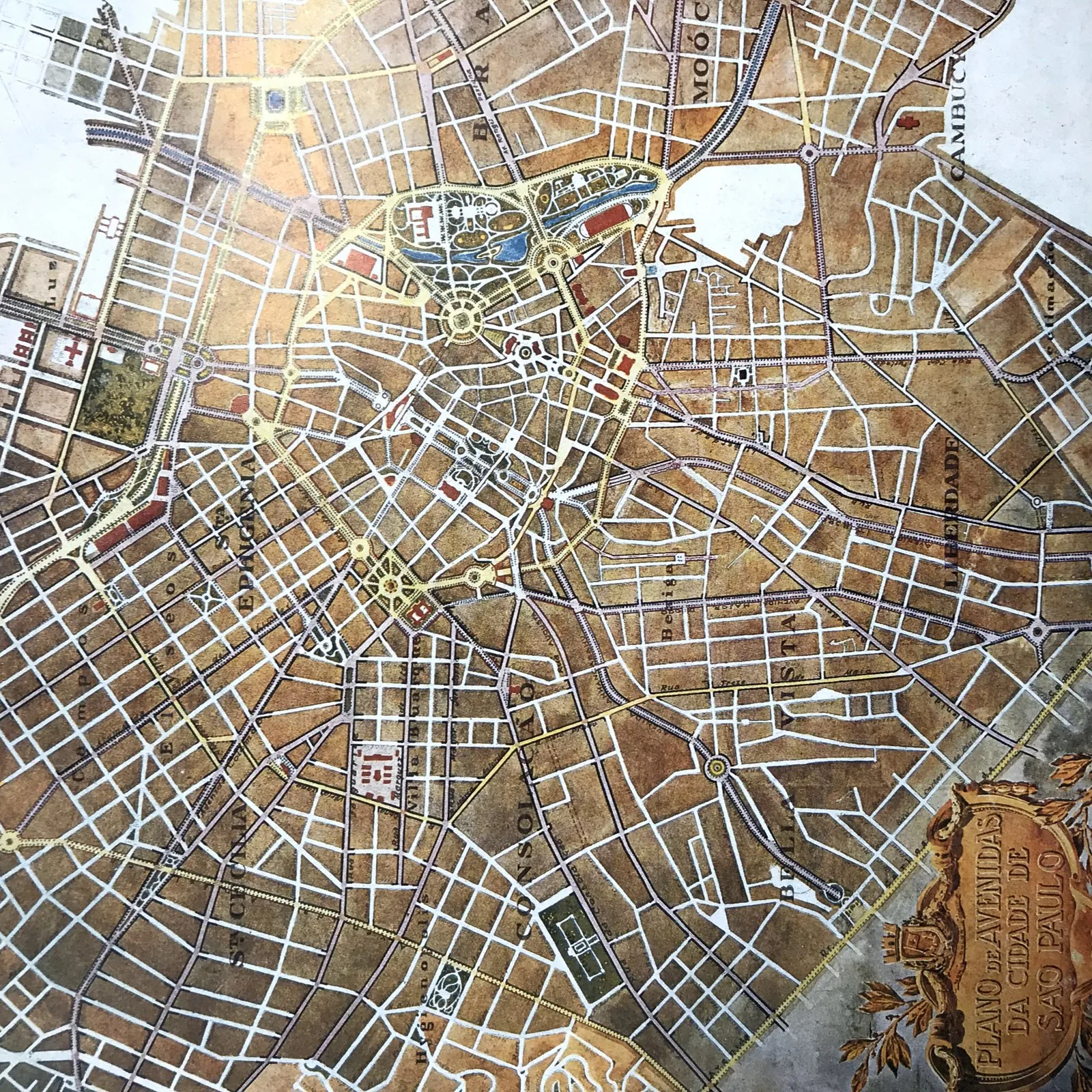
A road-based restructuring plan for São Paulo developed by the engineer Francisco Prestes Maia, published with João Florence de Ulhôa Cintra in 1930 and pursued during Prestes Maia's mayoralty from 1938. Its core was a radial-perimeter system of wide avenues centred on an inner ring, the Perímetro de Irradiação, with river valleys converted into arterial roads and successive outward rings anticipating metropolitan expansion. Large parts of the system were built, fixing the automobile-oriented structure of the growing metropolis.
Significance
The Plano de Avenidas set São Paulo decisively on a path of road-led growth and remains central to explanations of the city's congestion and its weak investment in rail transit. It exemplifies the engineer-planner tradition in Latin America, and later critics have treated it as a cautionary case of structuring a megacity around motorisation.
What shaped it
- Plan of Chicago (1909)
- The boulevard (17th–19th c.)
- The internal-combustion automobile (1886)
Plans it influenced
- Sao Paulo PDE 2014 / 2024 (2014/2024)
Sources
- https://en.wikipedia.org/wiki/Francisco_Prestes_Maia
- https://pt.wikipedia.org/wiki/Plano_de_Avenidas_de_S%C3%A3o_Paulo