St. Petersburg
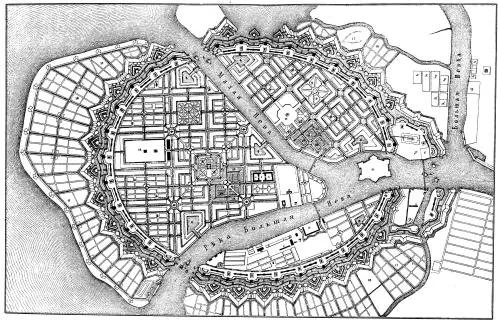
Core idea
Baroque radial-island structure and canals
Why it matters
Imperial scenography on a new site
Description
Peter the Great founded St. Petersburg in 1703 and built it from nothing on Baltic marshland as Russia's 'window on the West,' drained by canals and laid out with Baroque avenues radiating from the Admiralty. Foreign architects gave it a planned, monumental, European face imposed by absolute will.
Significance
St. Petersburg is the supreme example of the autocratic capital conjured from empty ground to reorient a nation. Its planned Baroque grandeur — built at enormous human cost — embodies the power of the absolutist state to will a city into being.
What became of it
The formal 1716 island plan was largely discarded in favour of Trezzini's more pragmatic layout, but St Petersburg was realised as a baroque island-and-canal capital and remains Russia's second city.
Critique
The idealised geometric island plan ignored the practical difficulties of the marshy Neva delta and was abandoned.
What shaped it
- The Enlightenment (18th c.)
- Peace of Westphalia (1648)
- Canal pound-lock (1681)
Plans it influenced
- Moscow General Plan (1935)
- St. Petersburg General Plan 2005 (2005)