Moscow General Plan
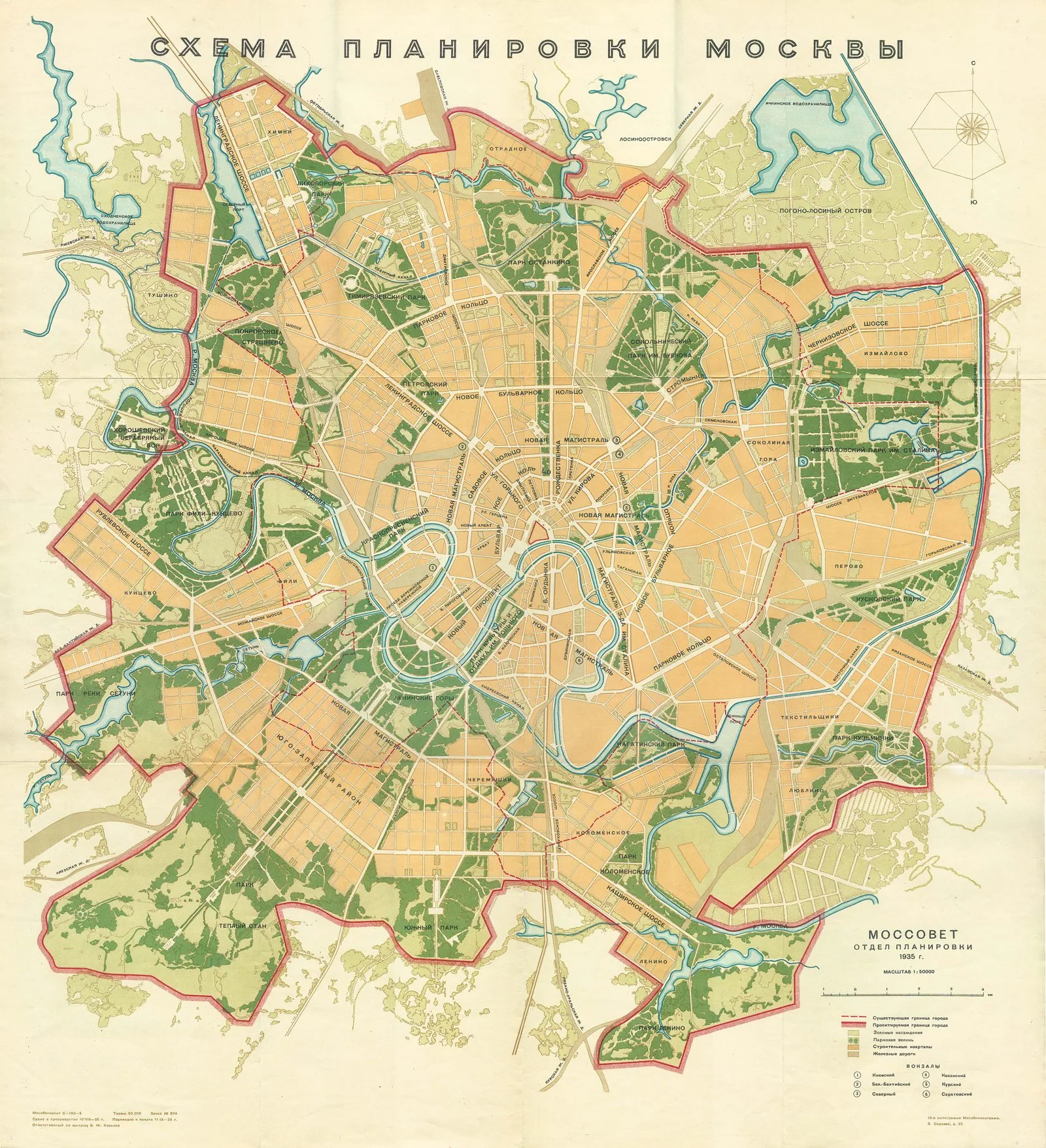
Core idea
Monumental radials, ring roads, metro, green wedges
Why it matters
Sets template for Soviet metropolitan form
Description
Stalin's 1935 General Plan for Moscow widened monumental avenues, drove the first metro lines, embanked the river, and reshaped the city around grand socialist-realist ensembles radiating from the Kremlin, projecting the power of the Soviet state.
Significance
The 1935 Moscow plan is the great example of socialist-state urbanism, fusing monumental scale, mass transit, and ideology. Its boulevards, metro, and ringed structure still define Moscow and influenced capitals across the socialist world.
What became of it
Partially realised: the radial-ring road system, metro extensions, embankments and monumental set-pieces were built, but the full 10-year programme was interrupted by WWII and only partly completed.
Critique
Scholars note the plan subordinated the historic centre to monumental Stalinist set-pieces, demolishing much heritage fabric in the process.
What shaped it
- Marx & socialism (1848 / 1867)
- Communism and the USSR (1917 / 1922)
- The boulevard (17th–19th c.)
- The metro / underground railway (1863)
- The Athens Charter (1933 / 1943)
Plans it influenced
- Moscow General Plan 2025 Update (2010)
- Minsk General Plan 2030 (2010)
- Warsaw Centrum Praskie Koneser Area Plan (2010s)
- Kraków Nowa Huta (historic plan) (1949)
- Soviet General Scheme of Settlement (Generalnaya skhema rasseleniya) (1975)
- Tashkent Reconstruction Master Plan (post-1966 earthquake) (1966)
- Ashgabat Reconstruction General Plan (post-1948 earthquake) (1949)
- Bucharest Civic Centre (Centrul Civic, systematisation) (1983)
Sources
- https://en.wikipedia.org/wiki/General_Plan_for_the_Reconstruction_of_Moscow
- https://soviethistory.msu.edu/1936/rebuilding-of-moscow/