Surakarta (Solo) Kraton
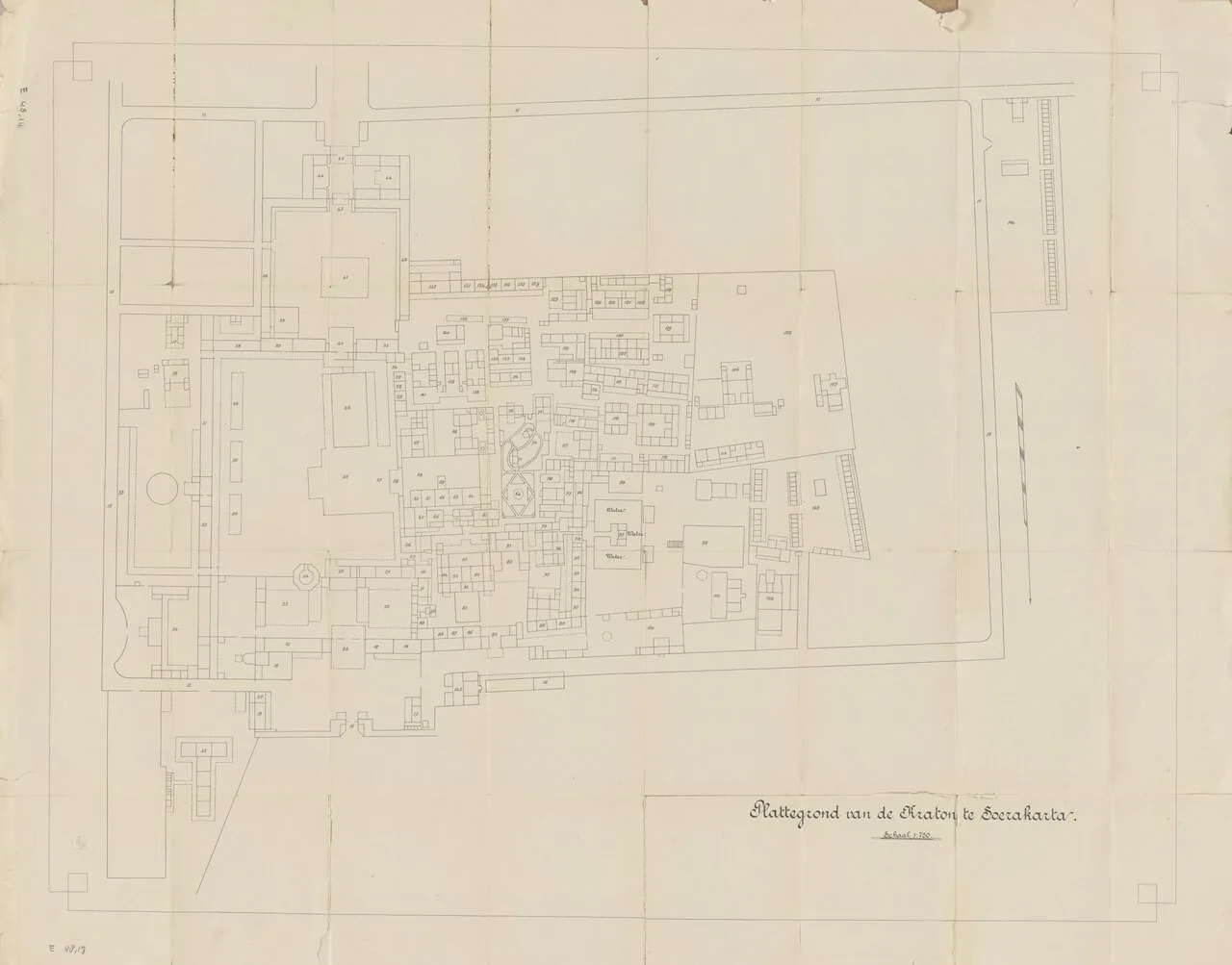
Core idea
Mataram court capital laid out as a cosmological mandala.
Why it matters
Final Mataram capital embodying the king-at-the-centre city.
Description
The Kraton Kasunanan Surakarta was founded in 1745 when Sunan Pakubuwono II moved the Mataram court from Kartasura to the village of Sala on the Bengawan Solo river. Conceived as a cosmological mandala, the walled palace city was organised in concentric zones with the ruler as axis mundi at its centre and a strong north–south ceremonial spine linking the northern and southern alun-alun squares. The rectangular complex, ringed by a high wall, was symbolically oriented toward sacred Mount Merapi. Together with Yogyakarta, Surakarta is one of the two successor courts of Mataram and remains an active royal and cultural centre in Central Java.
Significance
Surakarta is significant as a fully realised Javanese cosmological capital, in which Hindu-Buddhist mandala principles and the metaphor of the king at the centre of the universe were translated into concentric walls, ceremonial squares and a sacred north–south axis. As one of the two surviving Mataram courts, it preserves the spatial ideology of pre-colonial Javanese kingship and remains a living reference for the study of Southeast Asian palace-cities.
What shaped it
- The vastu-purusha mandala diagram (c. 6th c. CE (codified))
- Christianity & Islam (1st c. CE / 622 CE)
- Ottoman, Mughal and Qing imperial states (16th–18th c.)