Tama New Town
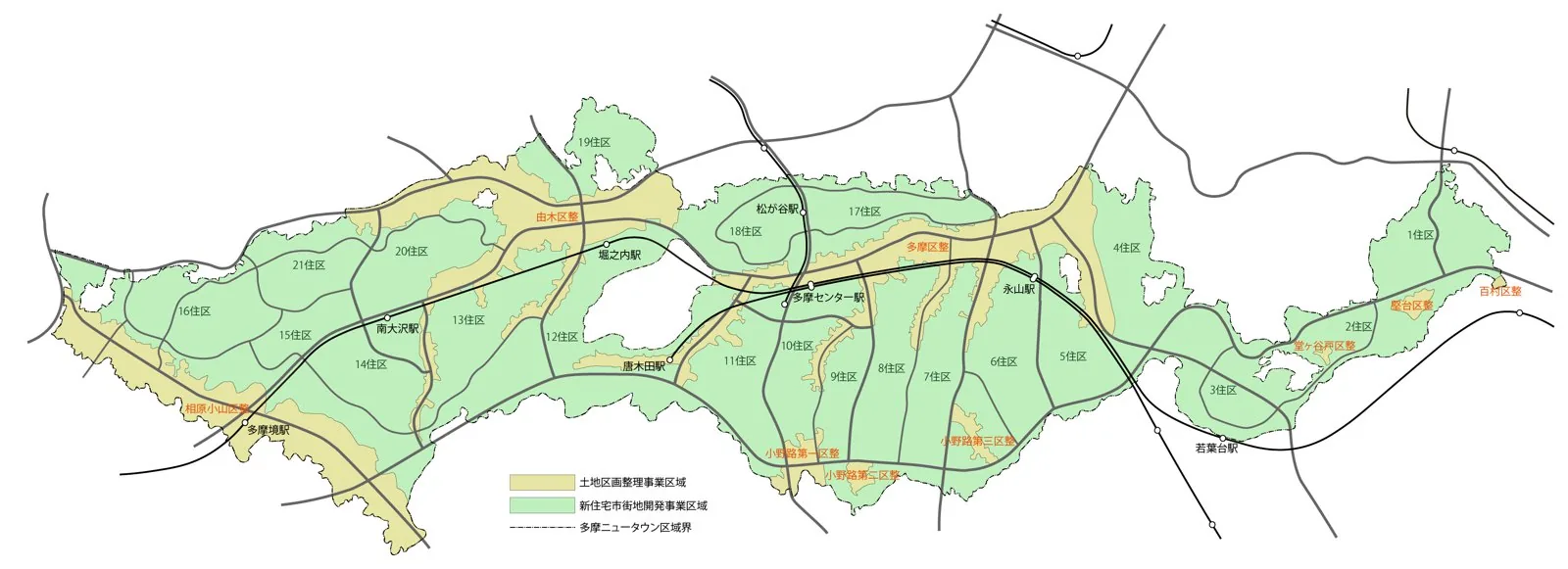
Core idea
Mass housing satellite with rail
Why it matters
Largest Japanese new town
Description
Tama New Town, developed from 1965 across the Tama Hills west of Tokyo by the Tokyo Metropolitan Government together with national housing agencies, is Japan's largest planned new town. The plan organised mass housing estates into neighbourhood units served by schools, local centres and pedestrian networks, with the whole settlement structured around new commuter rail lines linking residents to central Tokyo.
Significance
Tama New Town exemplifies the Japanese adaptation of the new-town idea to a rail-commuting metropolis, coupling welfare-state mass housing with private and public railway investment. It housed a substantial share of Tokyo's postwar suburban growth and later became a leading case in debates on the ageing of new towns, as its early estates and their populations grew old together.
What shaped it
- The Neighbourhood Unit (1929)
- The metro / underground railway (1863)
- The master plan (early 20th c.)
Plans it influenced
Sources
- https://en.wikipedia.org/wiki/Tama_New_Town
- https://www.toshiseibi.metro.tokyo.lg.jp/documents/d/toshiseibi/pdf_keikaku_chousa_singikai_pdf_