Seoul New Towns (Bundang, Ilsan, etc.)
Core idea
Mass new towns linked by metro
Why it matters
Absorbed growth with high quality of life
Description
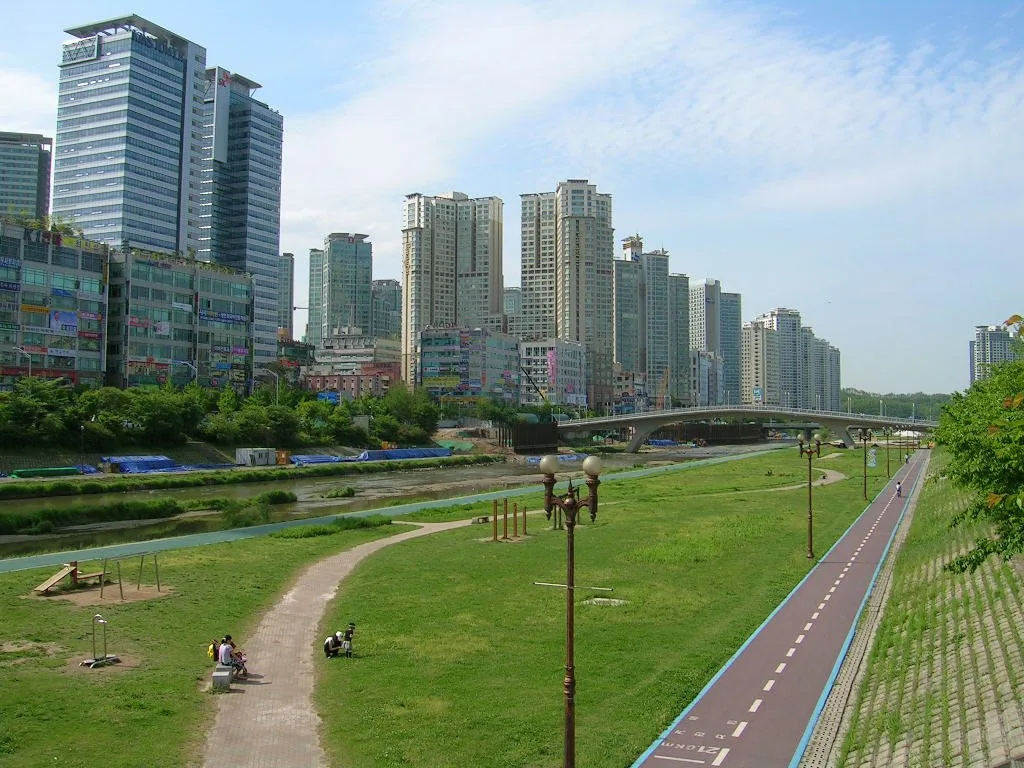
The first-generation Seoul new towns, including Bundang, Ilsan, Pyeongchon, Sanbon and Jungdong, were planned in the late 1980s and built through the 1990s by the Korea Land and Housing Corporation to relieve an acute housing crisis in the capital region. Each was a high-density satellite of apartment estates, district centres and parks, developed at great speed under the Two Million Homes programme and connected to Seoul by extensions of the metropolitan railway and metro network. Bundang and Ilsan in particular became large middle-class cities in their own right.
Significance
The programme demonstrated that mass housing delivery at extraordinary speed could be combined with rail-linked structure and a quality of life attractive to the middle class, absorbing metropolitan growth on a scale few countries have matched. It consolidated the high-rise apartment complex as the dominant Korean residential form and became the template for later new town rounds, while also feeding debates on dormitory-town dependence and the speculative dynamics of the Seoul housing market.
What shaped it
- New Towns Act (1946)
- The metro / underground railway (1863)
- Garden Cities of To-Morrow (1898 / 1902)
Plans it influenced
Sources
- https://en.wikipedia.org/wiki/Korea_Land_%26_Housing_Corporation
- https://webimages.iadb.org/publications/english/document/Korea-Pursuit-for-Sustainable-Cities-th