Arcosanti
Core idea
A compact, car-free desert prototype fusing architecture and ecology into one structure.
Why it matters
The built testing ground for Soleri's 'arcology' against suburban sprawl.
Description
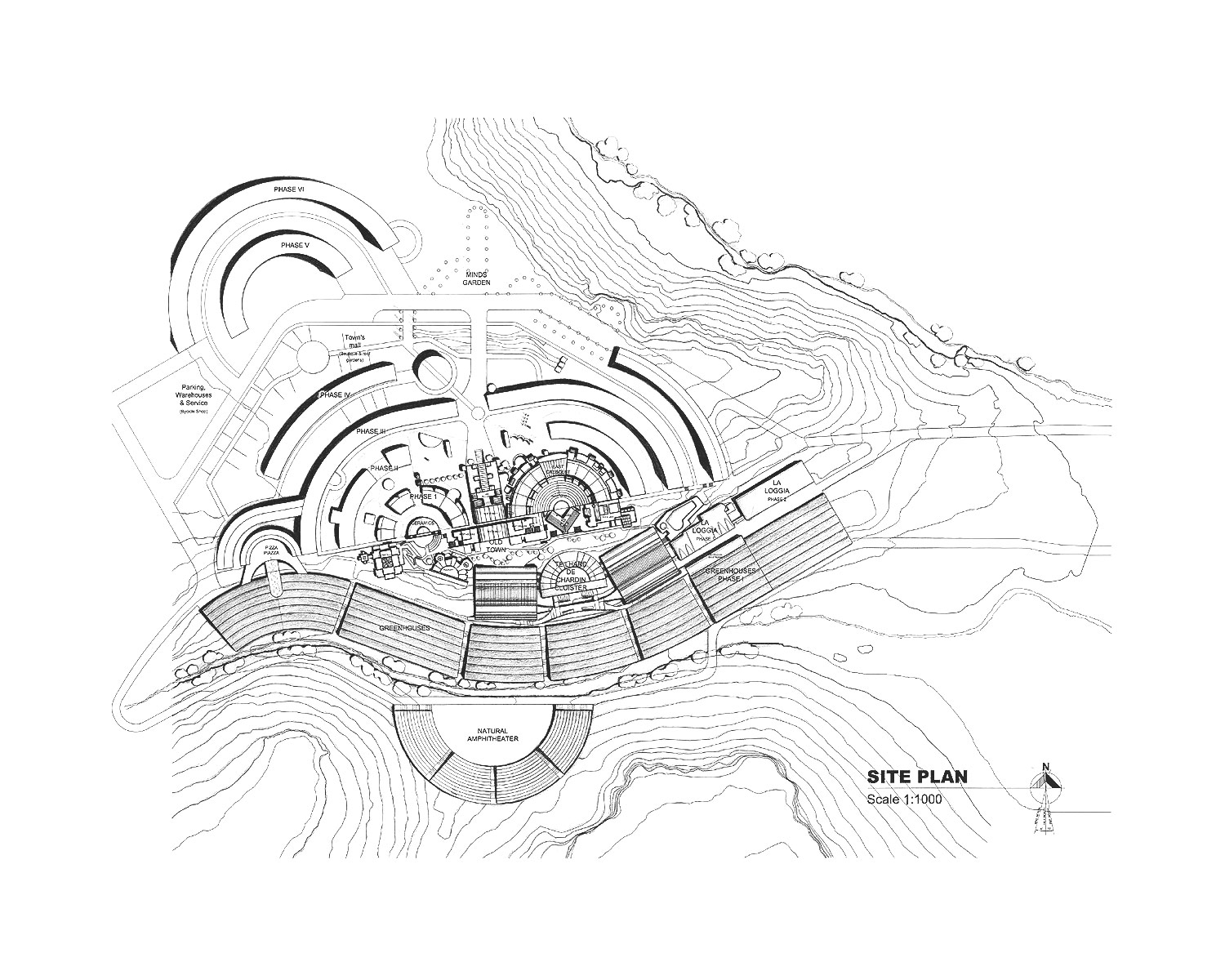
Arcosanti is an experimental settlement begun in 1970 by the architect Paolo Soleri and the Cosanti Foundation on a high-desert mesa in central Arizona. It was conceived as a prototype 'arcology', a term Soleri coined from architecture and ecology to describe a dense, three-dimensional urban form that concentrates living, working and community functions into a single compact structure and so eliminates the need for the car. Built incrementally by volunteers using cast and earth-formed concrete, the site groups apsidal vaults, workshops and housing around shared spaces, exploiting solar orientation for passive heating and cooling. Designed for several thousand residents, it remains only partly realised but continues as an inhabited project.
Significance
Arcosanti is the principal built demonstration of Soleri's arcology, offering a critique of post-war suburban sprawl through extreme compactness, mixed use and ecological integration. By concentrating the city into a walkable three-dimensional structure it sought to reduce land consumption, energy use and social isolation. Though never completed at its intended scale, it has been an influential reference for compact, low-impact and self-built urbanism and a long-running pedagogical experiment.
What became of it
Never completed and now in decline, with workshops ceased and most staff laid off by 2025, it remains a c.5 per cent-built prototype.
Critique
The arcology depended on volunteer labour and a self-funding craft economy that never scaled to support real construction.
What shaped it
- Ecology (1866 / 1935)
- Ekistics (1968)
- Silent Spring (Carson) (1962)
- Utopia (1516)
- The pedestrian zone (1953)
- The City in History (1961)
Plans it influenced
- Dongtan Eco-city (unbuilt) (2005–)
- Freiburg Vauban (1993–)
- Masdar City Masterplan (2006–)