Berlin Hobrechtplan
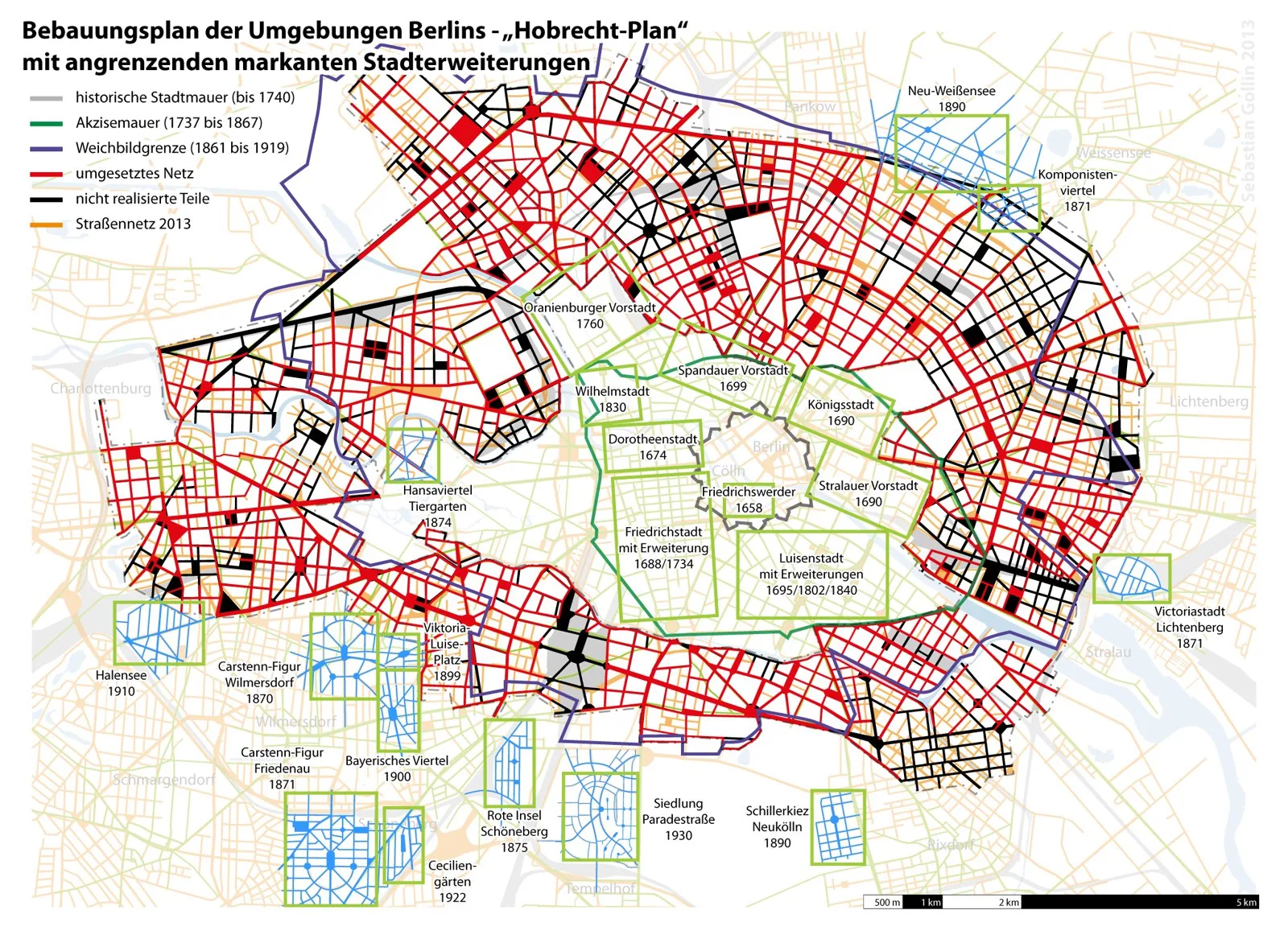
Core idea
Ring-radial skeleton; perimeter blocks
Why it matters
Framework for metropolitan Berlin’s growth
Description
James Hobrecht's 1862 plan guided Berlin's explosive growth with a framework of broad ring and radial streets and large blocks — but its deep plots and permissive density produced the notorious 'Mietskasernen,' tenement blocks wrapped around a series of cramped interior courtyards.
Significance
The Hobrechtplan is a cautionary classic: a rational street framework whose lax control of block interiors produced overcrowded tenements. It became central to debates on housing reform and the social consequences of planning decisions.
What became of it
Implemented from 1862 as the skeleton of Greater Berlin's expansion; its large perimeter blocks were filled by speculative builders into the dense Mietskaserne (rental-barracks) tenements that defined the late-19th-century city.
Critique
By fixing only the street grid and large blocks without controlling block interiors, the plan enabled extreme overbuilding and overcrowded courtyard tenements - a failure Hobrecht himself acknowledged in 1893.
What shaped it
- The boulevard (17th–19th c.)
- The sewer / sanitary drain (c. 2500 BCE)
- Industrial Revolution accelerates (c. 1769)
Plans it influenced
- Amsterdam Plan Zuid (1915–1917)
- Planwerk Innenstadt, Berlin (1999)
- Greater Berlin Competition (1910)
Sources
- https://en.wikipedia.org/wiki/Hobrecht-Plan
- https://journal-buildingscities.org/articles/10.5334/bc.242