Borobudur and the Kedu Plain (Medang/Mataram)
Core idea
A mandala-plan Buddhist monument anchoring a temple landscape that expressed cosmological order on the Kedu Plain.
Why it matters
A built mandala that organised territory and belief, exemplifying cosmological urbanism in early Java.
Description
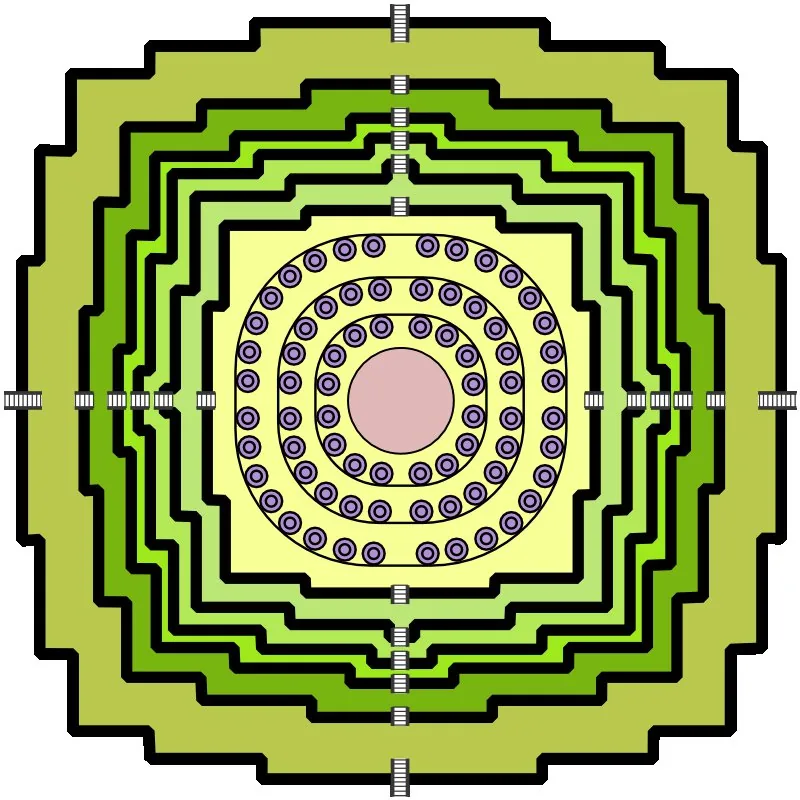
Borobudur rises from the Kedu Plain of Central Java, built in the late eighth and first half of the ninth centuries under the Shailendra dynasty of the Medang, or Mataram, kingdom. Conceived as a colossal stepped stupa, it embodies Mahayana Buddhist cosmology as a three-dimensional mandala: square terraces of narrative reliefs ascend to circular platforms of perforated stupas and a crowning central stupa, guiding pilgrims through a symbolic ascent. The monument anchored a wider sacred landscape, as the Shailendras covered the fertile, rice-growing Kedu Plain with associated temples and shrines. Aligned with surrounding volcanoes and neighbouring monuments, Borobudur ordered both belief and territory across the agrarian heartland.
Significance
Borobudur shows how a Javanese dynasty used monumental, mandala-based geometry to organise religious experience and structure a sacred territorial landscape. As one of the world's great Buddhist monuments, it demonstrates cosmological planning at the scale of both building and region. The Kedu Plain ensemble is central to understanding how cosmology, agriculture and statecraft shaped early Southeast Asian urbanism.
What shaped it
- Buddhism (c. 5th c. BCE)
- Vastu Shastra / Mayamata / Manasara (c. 6th c. CE)
- The vastu-purusha mandala diagram (c. 6th c. CE (codified))
Plans it influenced
- Angkor (Khmer Empire) (c. 9th–13th c.)