Córdoba (Umayyad Caliphate)
Core idea
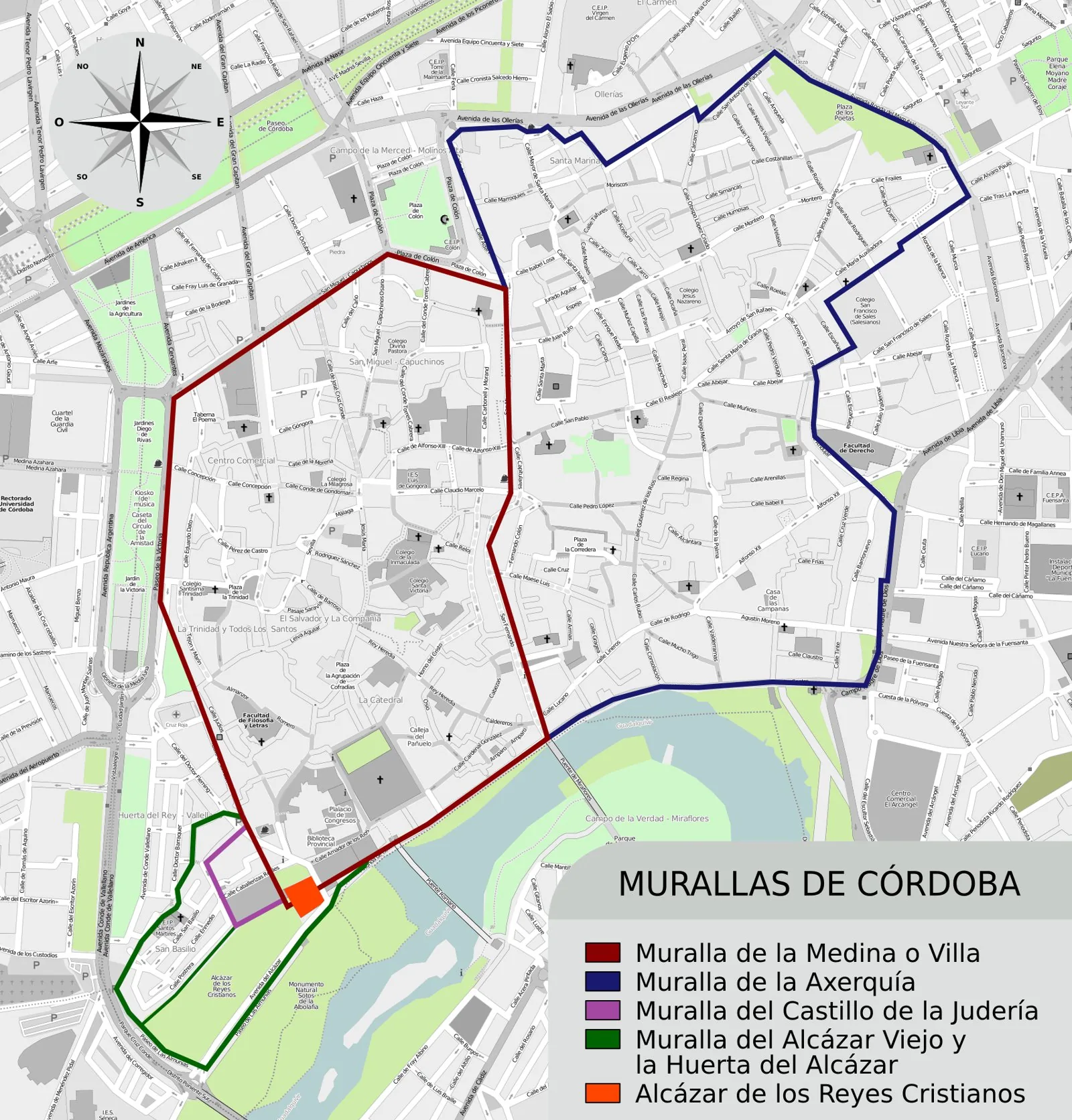
Capital of Islamic Iberia centered on the Great Mosque (Mezquita), with paved and lit streets, aqueducts, public baths, and the suburban palace-city of Madinat al-Zahra
Why it matters
Largest and most advanced city in 10th-century Europe; demonstrates Islamic urban infrastructure (lighting, sanitation, water) centuries ahead of Christian Europe
Description
As capital of the Umayyad emirate and later caliphate of al-Andalus (756–1031), Córdoba became the most sophisticated city in 10th-century Europe, centered on the vast Great Mosque (Mezquita) and supplied by aqueducts feeding public fountains and baths. Contemporary accounts describe paved, lamp-lit streets and hundreds of bathhouses, while the nearby palace-city of Madinat al-Zahra projected caliphal power as a planned royal suburb.
Significance
Córdoba demonstrates that medieval Islamic cities ran centuries ahead of Christian Europe in sanitation, water supply, street lighting, and scale. It is essential for decentering the standard 'dark ages' narrative and showing how knowledge, infrastructure, and urban refinement flowed from the Islamic world into later European urbanism.
What became of it
Capital of al-Andalus and from 929 the Umayyad Caliphate; it was sacked during the Fitna (civil war) of 1009-1031, the palatine city of Madinat al-Zahra was destroyed, and Cordoba shrank greatly after the caliphate's fall in 1031, though the Great Mosque survives (later converted to a cathedral).
Critique
The popular image of Cordoba as a uniquely tolerant multi-faith 'ornament of the world' has been criticised by revisionist historians as romanticised, understating coercion and the legal subordination of non-Muslims under the dhimma system.
What shaped it
- The Caliphates (632–1258)
- The aqueduct (c. 700 BCE)
- The hammam (public bath) (developed c. 7th–9th c.)
- Christianity & Islam (1st c. CE / 622 CE)
Plans it influenced
- Cairo (Fatimid al-Qahira) (969)
- Fez (Fes el-Bali) (789)
Sources
- https://en.wikipedia.org/wiki/Umayyad_state_of_C%C3%B3rdoba
- https://www.nationalgeographic.com/history/history-magazine/article/cordobas-mosque-cathedral-sh