Fujiwara-kyō
Core idea
Japan's first Chinese-style grid-planned capital, with the palace set at the centre of the grid
Why it matters
Established the planned grid capital in Japan and served as the direct predecessor to Nara
Description
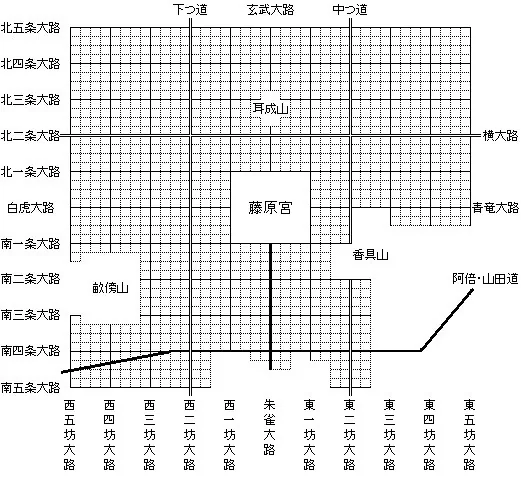
Established in 694 under Empress Jitō, on plans begun by her predecessor Emperor Tenmu, Fujiwara-kyō was Japan's first true Chinese-style grid-planned capital, modelled on Tang Chang'an. It was laid out as a rectangular street grid roughly 5 km on a side, divided by a north-south Suzaku Avenue. Distinctively, the Fujiwara Palace stood at the centre of the grid rather than along its northern edge, an arrangement some scholars associate with the central-palace ideal of the Rites of Zhou rather than the northern-palace model later adopted at Nara. It housed the court, government ministries and aristocratic residences until the capital moved to Heijō-kyō in 710.
Significance
Fujiwara-kyō was the first fully grid-planned, permanent Chinese-style capital in Japan, embodying the consolidation of centralised imperial ritsuryō authority in built form. Brief though its life was, it served as the template and direct predecessor for Heijō-kyō at Nara and, in turn, Heian-kyō at Kyoto, establishing the planned orthogonal grid as the enduring form of the classical Japanese capital for centuries.
What became of it
Japan's first Chinese-style grid capital (694), it was abandoned after only sixteen years when Empress Genmei moved the court to Heijo-kyo (Nara) in 710, reportedly partly unfinished; the site is now agricultural land with excavated palace ruins.
Critique
Excavation has shown the canonical 'palace at the exact centre' ideal was imperfectly realised and that the capital may have been left incomplete, complicating its textbook status as a fully achieved planned city.
What shaped it
- The walled-ward (fang) city system (Sui–Tang, c. 6th–9th c.)
- The grid (c. 2500 BCE)
- Buddhism (c. 5th c. BCE)
- Kaogongji (Artificers' Record) (c. 5th c. BCE)
Plans it influenced
- Heijō-kyō (Nara) (710)
- Heian-kyō (Kyoto) (794)
Sources
- https://en.wikipedia.org/wiki/Fujiwara-ky%C5%8D
- https://en.japantravel.com/nara/fujiwara-capital-and-palace-ruins/51924