Kairouan
Core idea
Founded Islamic garrison-capital (misr) of Ifriqiya anchored by its Great Mosque.
Why it matters
Earliest Arab-Muslim foundation in the Maghreb and model for its later mosque cities.
Description
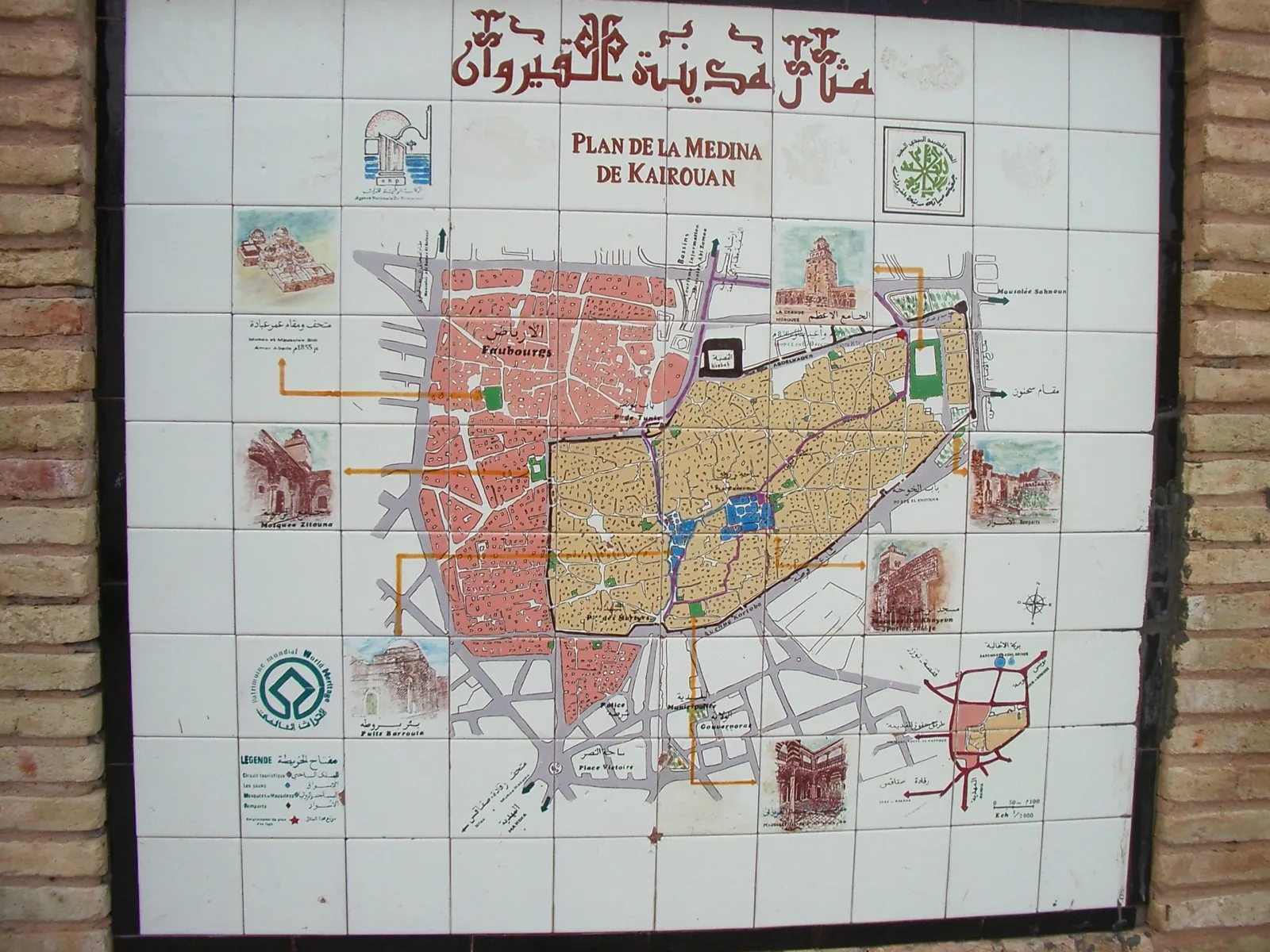
Kairouan was founded in 670 CE by the Arab general Uqba ibn Nafi as a military base, or misr, from which to consolidate Muslim rule across Ifriqiya, and it became the region's principal capital for several centuries. The city developed around its Great Mosque, an early congregational mosque whose plan and minaret became a model for later mosques throughout the Maghreb. Under the Aghlabid dynasty in the ninth century it flourished as a centre of religion, learning and trade, equipped with major hydraulic works including the open-air Aghlabid basins, paired cisterns that supplied water to the town and its surrounding gardens.
Significance
As the first enduring Arab-Muslim urban foundation in the Maghreb, Kairouan established the template of the garrison-capital centred on a great congregational mosque, shaping the form of later North African cities. Long regarded as one of Islam's holy cities and inscribed as a UNESCO World Heritage site, it preserves an exceptional medieval Islamic urban ensemble of mosque, medina and monumental water infrastructure.
What shaped it
- The Arab–Islamic conquests (7th–8th c. (from 632))
- The Caliphates (632–1258)
- Christianity & Islam (1st c. CE / 622 CE)
Plans it influenced
- Cairo (Fatimid al-Qahira) (969)
- Fez (Fes el-Bali) (789)