King Abdullah Financial District (KAFD), Riyadh
Core idea
Financial CBD with mixed use
Why it matters
Central element of Riyadh’s diversification
Description
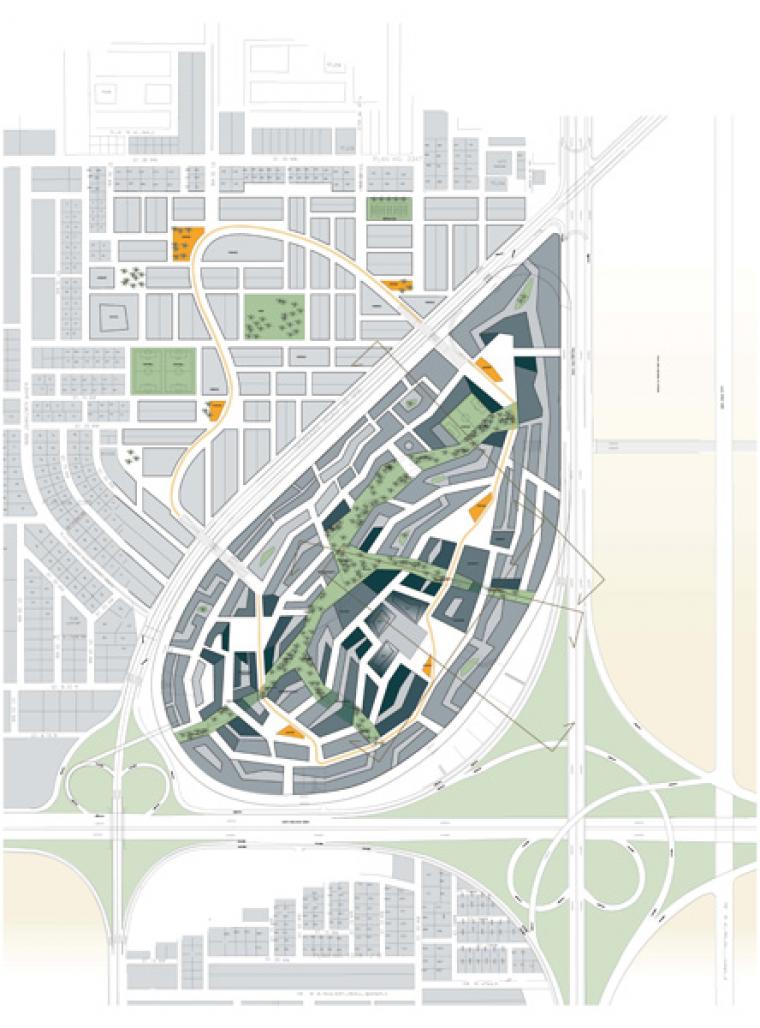
The King Abdullah Financial District is a purpose-built financial centre in northern Riyadh, initiated from 2006 with an early masterplan by Henning Larsen Architects and later developed under Saudi Arabia's Public Investment Fund. The plan concentrates dozens of high-rise office towers, a financial academy, conference facilities, housing and retail on a compact site, connected by an elevated skywalk network, a climate-modifying urban form and a dedicated monorail. It was conceived to gather the kingdom's banking and financial institutions into a single, internationally competitive district.
Significance
KAFD is a prominent example of the state-led financial district as an instrument of economic diversification, comparable to Dubai's DIFC and other Gulf clusters. Its long period of vacancy after construction, followed by revival under Vision 2030, has made it a case study in the risks of supply-driven cluster building and in the ability of oil-funded states to absorb such risks and reposition megaprojects.
What shaped it
- Neoliberalism (1970s–1990s)
- The skyscraper (1885)
- Global financial crisis (2007–2009)
- Splintering Urbanism (Graham & Marvin) (2001)
Sources
- https://en.wikipedia.org/wiki/King_Abdullah_Financial_District
- https://www.pif.gov.sa/en/our-investments/our-portfolio/king-abdullah-financial-district/