La Ville Spatiale (Spatial City)
Core idea
A lightweight space-frame spanning above the existing city, infilled by its inhabitants.
Why it matters
The founding statement of 'mobile architecture' and user-determined megastructure.
Description
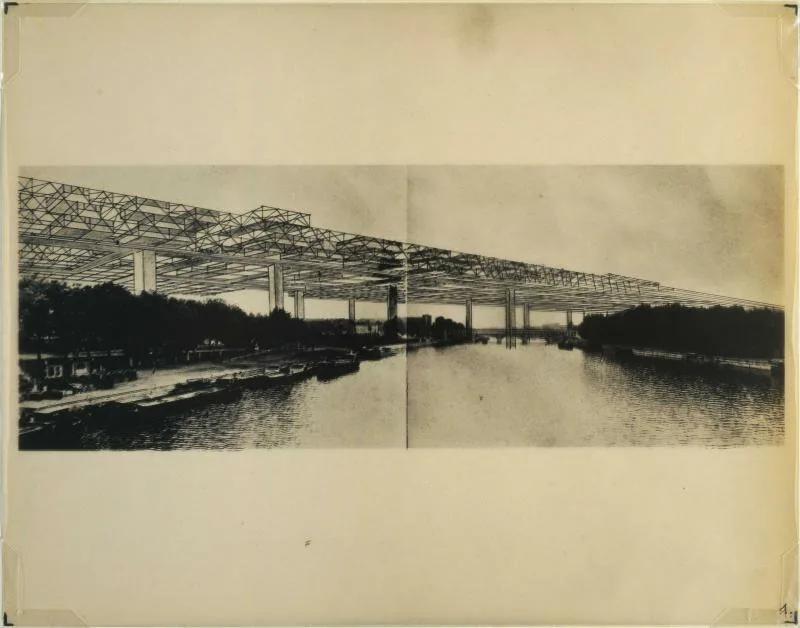
La Ville Spatiale is an unbuilt proposal developed by the architect Yona Friedman from 1958, growing out of his manifesto L'Architecture Mobile. It consists of a multi-storey space-frame grid raised on widely spaced piles above existing cities, water or unproductive land, leaving the ground free. This fixed structural infrastructure is left largely empty; within its voids the inhabitants insert and rearrange their own dwellings using movable walls and floors, so that the form of the city is determined by its users rather than by an architect. The city can grow over time and overlap the historic fabric beneath it without destroying it, expressed through diagrams of a permanent frame holding indeterminate, changeable contents.
Significance
The Spatial City gave the clearest theoretical form to 'mobile architecture' and to the principle that planners should provide an infrastructure while inhabitants determine the building within it. By separating a durable support from a freely changeable infill, and by floating new construction above the existing city, it offered an alternative to demolition-based renewal. Its ideas about indeterminacy, participation and the support-and-infill distinction influenced later open-building and megastructure thinking.
What became of it
Unbuilt theoretical project; influential as a manifesto for mobile architecture and user-built infrastructure, widely exhibited but never realised at city scale.
Critique
Critics observe that Friedman's faith in inhabitant self-determination understated the structural, regulatory and coordination demands of inserting individually built dwellings into a vast shared megaframe.
What shaped it
- Cybernetics & systems theory (1948 onward)
- CIAM founded (1928)
- The Athens Charter (1933 / 1943)
- The Image of the City (1960)
- The master plan (early 20th c.)
Plans it influenced
- Plan for Tokyo 1960 (unbuilt) (1960)
- Plug-in City (1964)
- Walking City (1964)
- A Plan for Tokyo, 1960 (1960)
- New Babylon (1959–1974)