Lübeck (Hanseatic)
Core idea
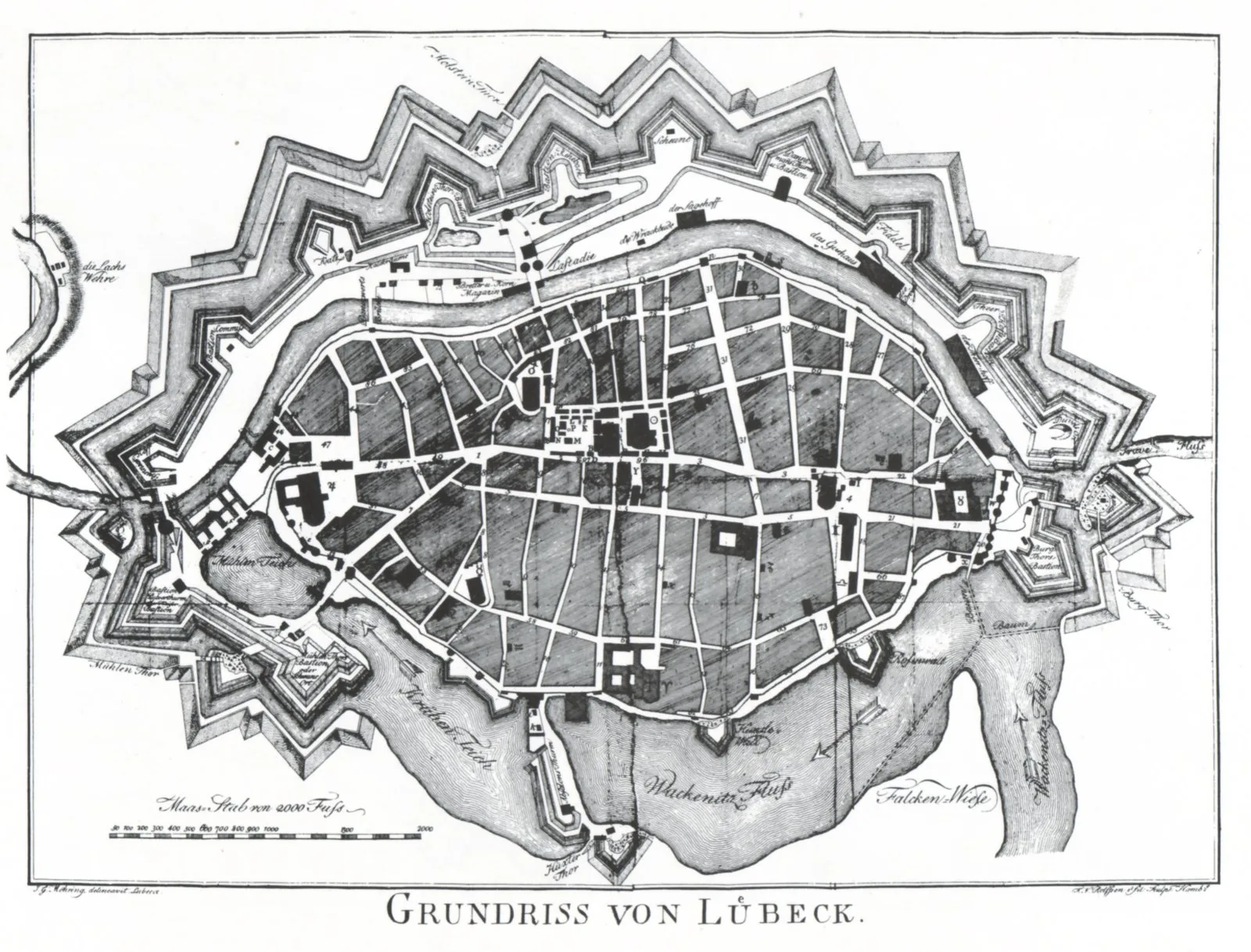
Planned merchant city on an island between two rivers — a spindle-shaped layout with the market and Rathaus at the crown and gabled merchant houses lining regular plots
Why it matters
"Queen of the Hanseatic League" and template for ~100 Baltic trading towns; codified the North-German merchant-city model and Brick Gothic civic architecture
Description
Refounded in 1143 on an island between two rivers, Lübeck was laid out as a planned merchant town with a spindle-shaped street network rising to the market square and Rathaus at its crown, lined by gabled brick merchant houses on regular plots. As the head of the Hanseatic League it coordinated a trading network across the Baltic and North Seas.
Significance
Lübeck was the template for roughly a hundred Hanseatic towns and codified the North-German merchant-city model and Brick Gothic civic architecture. It shows urban form generated by a commercial league rather than a monarch — bourgeois, mercantile, and self-governing.
What became of it
Realised largely as the planned 12th-c. merchant city and grew into the 'Queen of the Hanseatic League' and its administrative seat (from 1358); the spindle-shaped street plan, market and Rathaus survive, and the Old Town island is a UNESCO World Heritage Site among the best-preserved Hanseatic cityscapes.
Critique
The historic fabric, though celebrated as Germany's most complete Hanseatic townscape, was partly lost to WWII bombing (1942) and post-war rebuilding, complicating claims of unbroken medieval authenticity.
What shaped it
- The first universities (11th–13th c.)
Plans it influenced
- Salisbury (New Sarum) (1220)
- Bern (Zähringer Town) (1191)