Melaka
Core idea
Straits entrepôt reshaped by the A Famosa fortress and successive Portuguese and Dutch port-city forms
Why it matters
A colonial fortress-port controlling the spice route and a layered model of European trading-city urbanism in Asia
Description
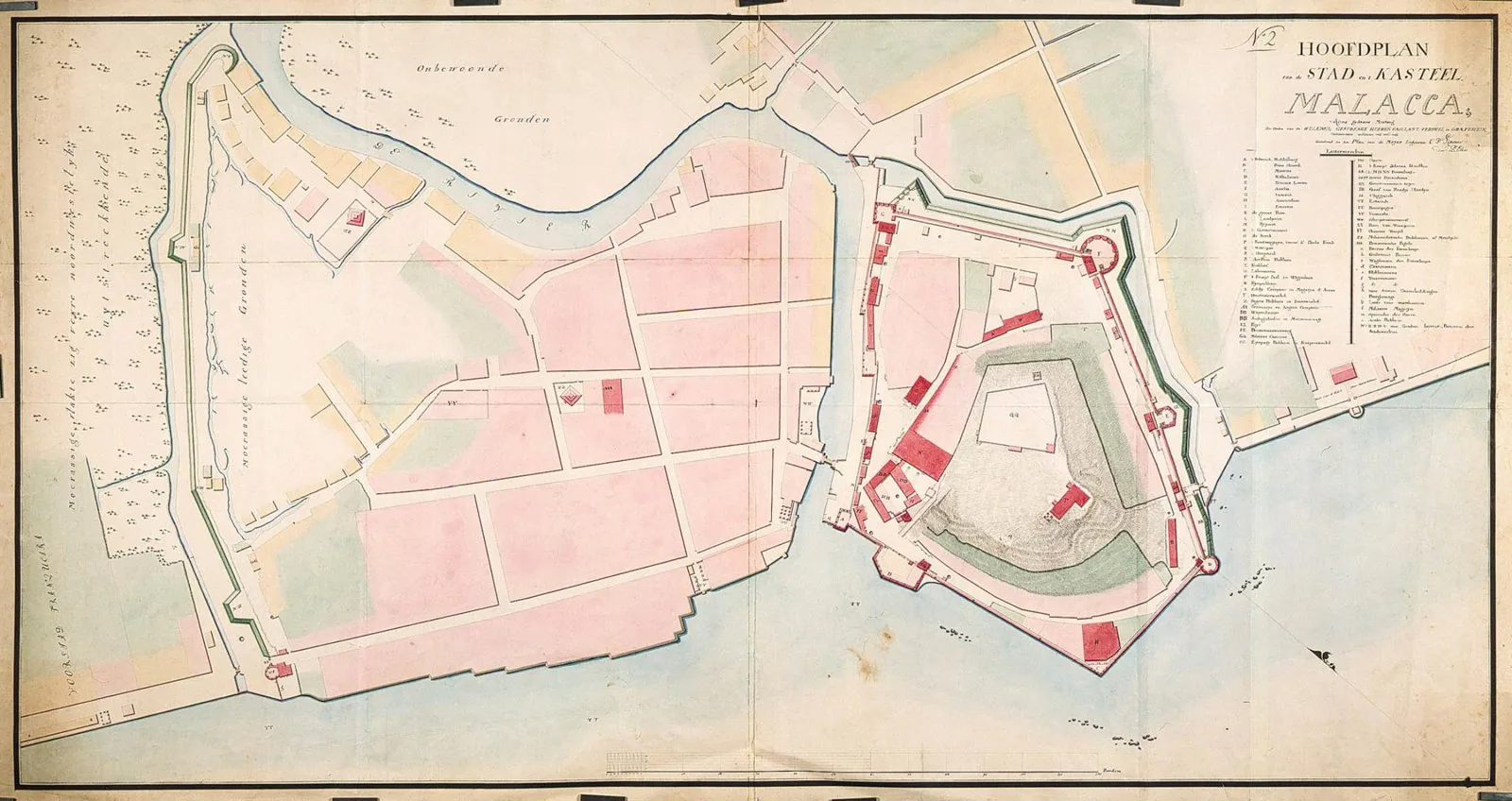
Melaka, a Malay sultanate commanding the strait that bears its name, was captured in 1511 by Afonso de Albuquerque, giving Portugal its first permanent foothold in Southeast Asia. The Portuguese fortified the hill at the river mouth with A Famosa, a stone fortress enclosing the governor's residence, churches, hospital and stores, one of the oldest surviving European structures in the Far East. After a long siege the Dutch East India Company seized the town in 1641 and overlaid its own ordered grid of streets, canals, churches and the red-laterite Stadthuys around a civic square. Successive colonial regimes thus left a stratified port-city morphology.
Significance
Melaka is a textbook case of the European trading-port city in Asia, where control of a single strait translated into command of the spice route between the Indian Ocean and the South China Sea. Its superimposed Portuguese fortress and Dutch civic grid, later joined by British and Straits-Chinese fabric, make it a layered record of colonial commerce and the morphology of the fortified entrepôt, recognised as a UNESCO World Heritage Site.
What became of it
Captured by Portugal in 1511 and only partially realised as a fortified entrepôt; held to 1641, then Dutch, then British. A Famosa was largely demolished by the British in 1807 (only the Porta de Santiago gate survives); trade primacy declined and Melaka was absorbed into colonial administration. UNESCO-listed.
Critique
Historians argue Portuguese fortress-and-feitoria urbanism strangled the open cosmopolitan entrepôt it conquered, diverting Muslim trade elsewhere and hastening Melaka's commercial eclipse.
What shaped it
- Ocean-going caravel, galleon and navigation (15th–16th c.)
- The Columbian Exchange (from 1492)
- The Treaty of Tordesillas (1494)