Monte Albán
Core idea
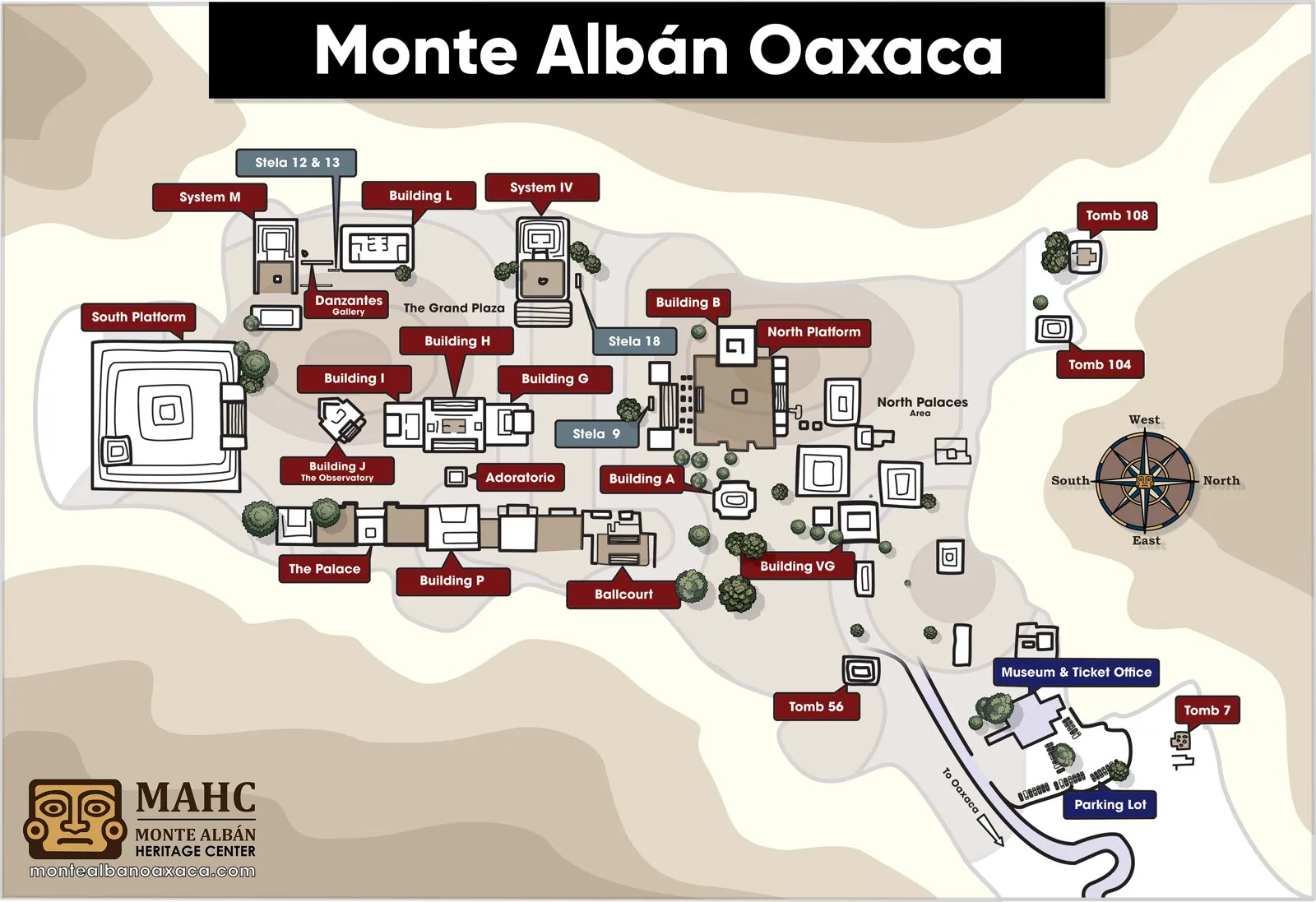
Mountaintop city built on a leveled ridge — a vast Main Plaza flanked by pyramids, observatory, and ballcourt, with terraced residences below
Why it matters
One of the earliest cities in Mesoamerica; demonstrates monumental terraforming and the political use of a commanding sacred-civic plaza
Description
Monte Albán was founded around 500 BCE by the Zapotec civilisation on a mountain ridge above the Valley of Oaxaca in present-day Mexico. Its builders levelled the hilltop to create a vast artificial Main Plaza flanked by pyramid platforms, temples, a ballcourt and the arrow-shaped Building J, often interpreted as an observatory, while terraced residences descended the slopes below. Set deliberately apart from farmland and water, the city was a political and ceremonial capital dominating the valley for over a thousand years.
Significance
Monte Albán is one of the earliest cities in Mesoamerica and a defining example of monumental terraforming, in which an entire landform was reshaped to create urban space. Its commanding sacred-civic plaza shows how early states used elevated, theatrical public space as an instrument of political authority, and the site remains central to debates about the origins of urbanism and state formation in the Americas.
What shaped it
- The Mesoamerican ceremonial centre and ballcourt (c. 500 BCE onward)
- The plaza / forum / agora (c. 500 BCE)
- The Axial Age (c. 800–200 BCE)
Plans it influenced
- Teotihuacan (c. 100 BCE–550 CE)
- Tikal (c. 4th c. BCE–900 CE)
- Calakmul (c. 4th–9th c. CE)
Sources
- https://www.britannica.com/place/Monte-Alban
- https://www.ebsco.com/research-starters/history/monte-alban