Teotihuacan
Core idea
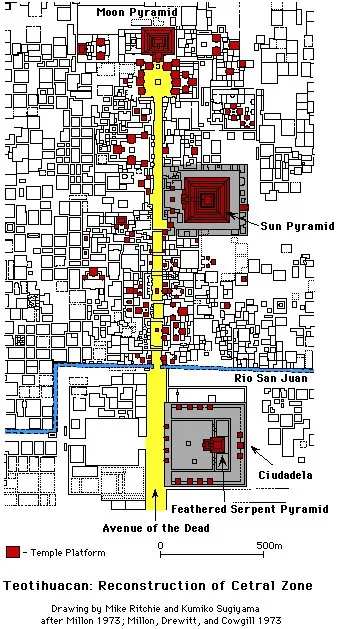
Avenue of the Dead as cosmic axis; Pyramid of the Sun and Moon; gridded residential compounds on a 15.5° offset
Why it matters
Largest city in the pre-Columbian Americas (~125,000 people); cosmological grid orientation influenced all subsequent Mesoamerican planning
Description
Teotihuacan dominated central Mexico from roughly 100 BCE to 550 CE, growing to perhaps 125,000 people on a rigorously planned grid offset 15.5° east of north. Its spine, the Avenue of the Dead, aligned the Pyramids of the Sun and Moon with the surrounding mountains and sky, while tens of thousands of residents lived in single-storey walled apartment compounds — a remarkably standardized, multi-ethnic urban housing system.
Significance
Teotihuacan is the great planned metropolis of the pre-Columbian Americas. Its cosmological grid orientation became a regional standard, and its scale and order shaped Mesoamerican city-making for a thousand years — even the Aztecs, arriving long after its fall, treated its ruins as the sacred 'place where the gods were created.'
What became of it
Grew from c. 100 BCE to a major planned city on the 15.5-degree-offset Avenue of the Dead axis; the civic-religious core was burned and the city largely collapsed/depopulated c. 550-650 CE, with the monumental complex left as ruins.
Critique
Smith et al. (2019) argue earlier population estimates were over-high, putting realistic density (~53/ha) and totals well below the often-quoted 150,000-200,000.
What shaped it
- The grid (c. 2500 BCE)
- The Mesoamerican ceremonial centre and ballcourt (c. 500 BCE onward)
- The ziggurat / temple-platform (c. 3000 BCE)
- Agriculture and the Neolithic revolution (from c. 9500 BCE)
Plans it influenced
- Tenochtitlan (1325–1521)
- Chichén Itzá (c. 600–1200 CE)