Tenochtitlan
Core idea
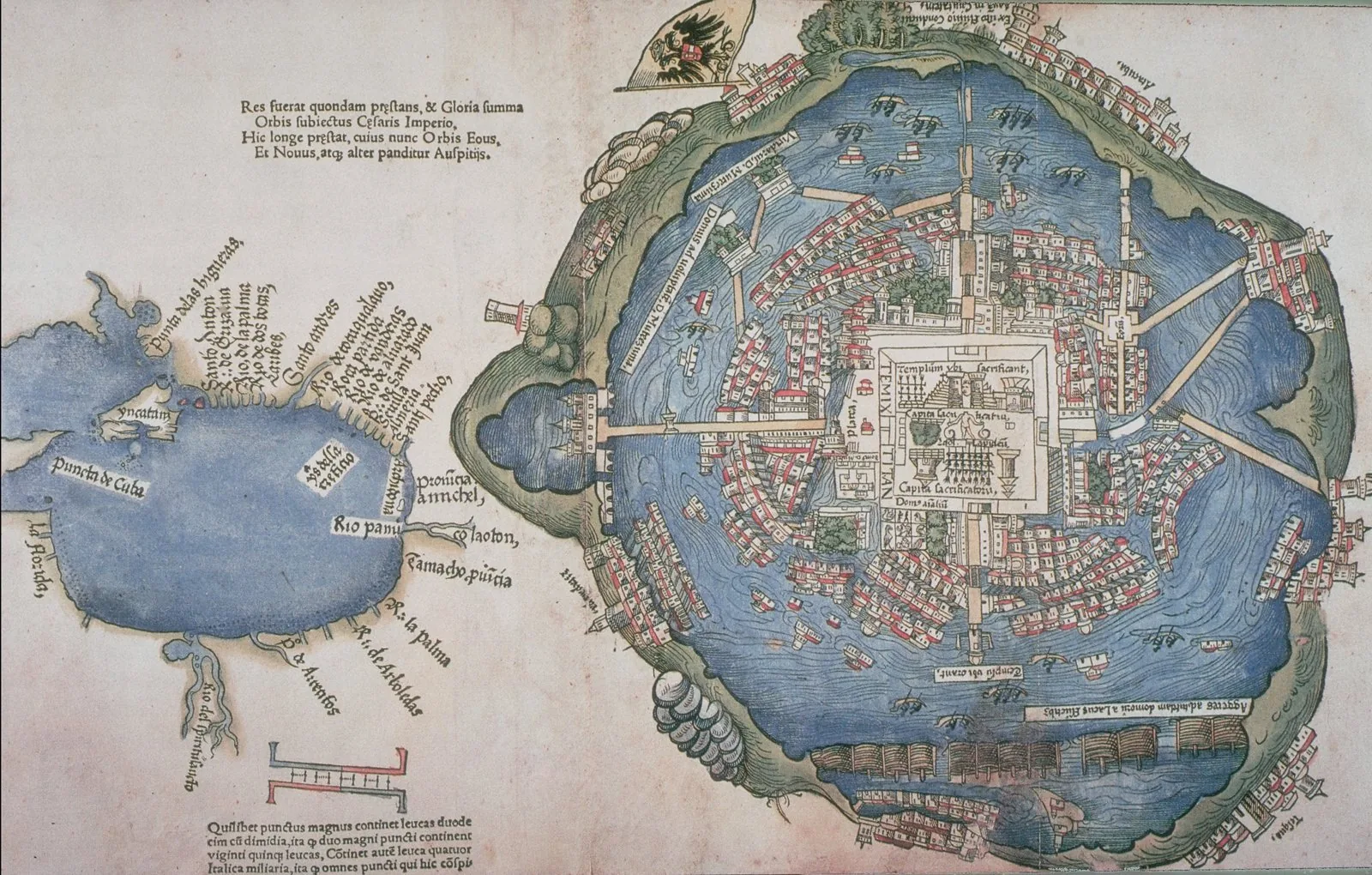
Island-capital on Lake Texcoco with four-quadrant causeways, chinampas (floating gardens), aqueducts, and Templo Mayor at center
Why it matters
Largest city in the Americas at contact (~200,000); hydraulic urbanism and cosmological quadrant structure destroyed by colonization
Description
Founded by the Mexica in 1325 on an island in Lake Texcoco, Tenochtitlan grew into one of the largest cities on Earth, perhaps 200,000 strong, organized into four great quadrants around the sacred precinct of the Templo Mayor. Three broad causeways tied the island to the mainland, an aqueduct from Chapultepec brought fresh water, and a vast system of chinampas — fertile artificial islands — fed the population from the lake itself.
Significance
Tenochtitlan is the supreme example of hydraulic, cosmologically-ordered urbanism in the Americas, comparable in scale and sophistication to any Old World capital. Its deliberate destruction by the Spanish in 1521 and burial beneath Mexico City is one of history's starkest illustrations of how conquest erases indigenous urban achievement.
What became of it
Besieged and largely destroyed by Cortés in 1521, then deliberately razed and rebuilt as Spanish Mexico City directly atop the ruins; the lake was progressively drained, so the original island-and-causeway form is now buried beneath the modern capital.
Critique
Susan Evans and Matthew Restall argue the popular ~200,000 figure is physically implausible given the absence of multi-storey housing, estimating instead c.60,000–70,000 inhabitants.
What shaped it
- Founding of Tenochtitlan (1325 CE (traditional))
- Chinampa raised-field agriculture (c. 1150–1521 CE)
Plans it influenced
- Laws of the Indies (Ordenanzas) (1573)
- Cusco (Inca Capital) (c. 1400–1533)
Sources
- https://en.wikipedia.org/wiki/Tenochtitlan
- https://education.nationalgeographic.org/resource/tenochtitlan/