Postwar & Welfare-Modernist (1945–1975)
Stockholm General Plan
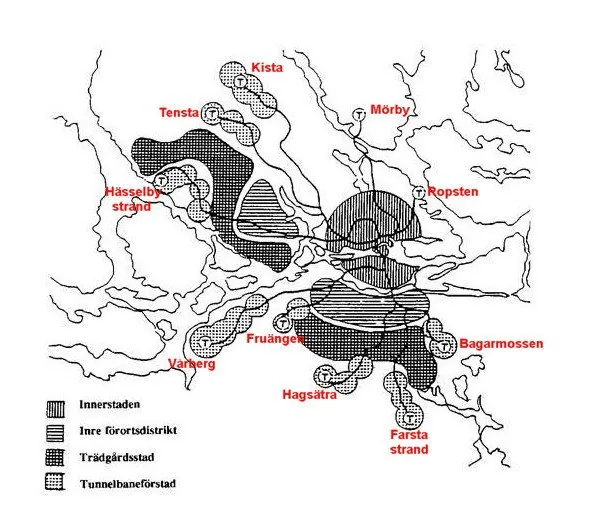
Core idea
Metro-anchored satellites (ABC towns)
Why it matters
Traffic segregation and transit-oriented growth
Description
Stockholm's 1952 General Plan directed postwar growth through new transit-served suburbs on municipally owned land, coordinating the metro's expansion with planned satellite communities and abundant green space under a strong public-led, welfare-state model.
Significance
The plan made Stockholm a model of welfare-state urbanism, showing how public land ownership and integrated transit planning could guide orderly, equitable, high-quality metropolitan growth.
What shaped it
- The metro / underground railway (1863)
- The Neighbourhood Unit (1929)
- Garden Cities of To-Morrow (1898 / 1902)
- The green belt (1898 concept / 1938 law)
Plans it influenced
- Stockholm RUFS 2050 (2018)
Sources
- https://portal.research.lu.se/en/publications/one-plan-multiple-models-the-general-plan-for-stoc
- https://books.google.com/books/about/Generalplan_for_Stockholm_1952.html?id=4fF6vwEACAAJ
hub.toekom.st — History of Urbanism · an interactive timeline of 850 planned cities across 6,000 years.