Tennessee Valley Authority (TVA) Regional Development Program
Core idea
Integrated river-basin agency coordinating dams, power, navigation and economic development across a multi-state region
Why it matters
First large federal regional-planning body, exported worldwide as the template for integrated basin modernisation
Description
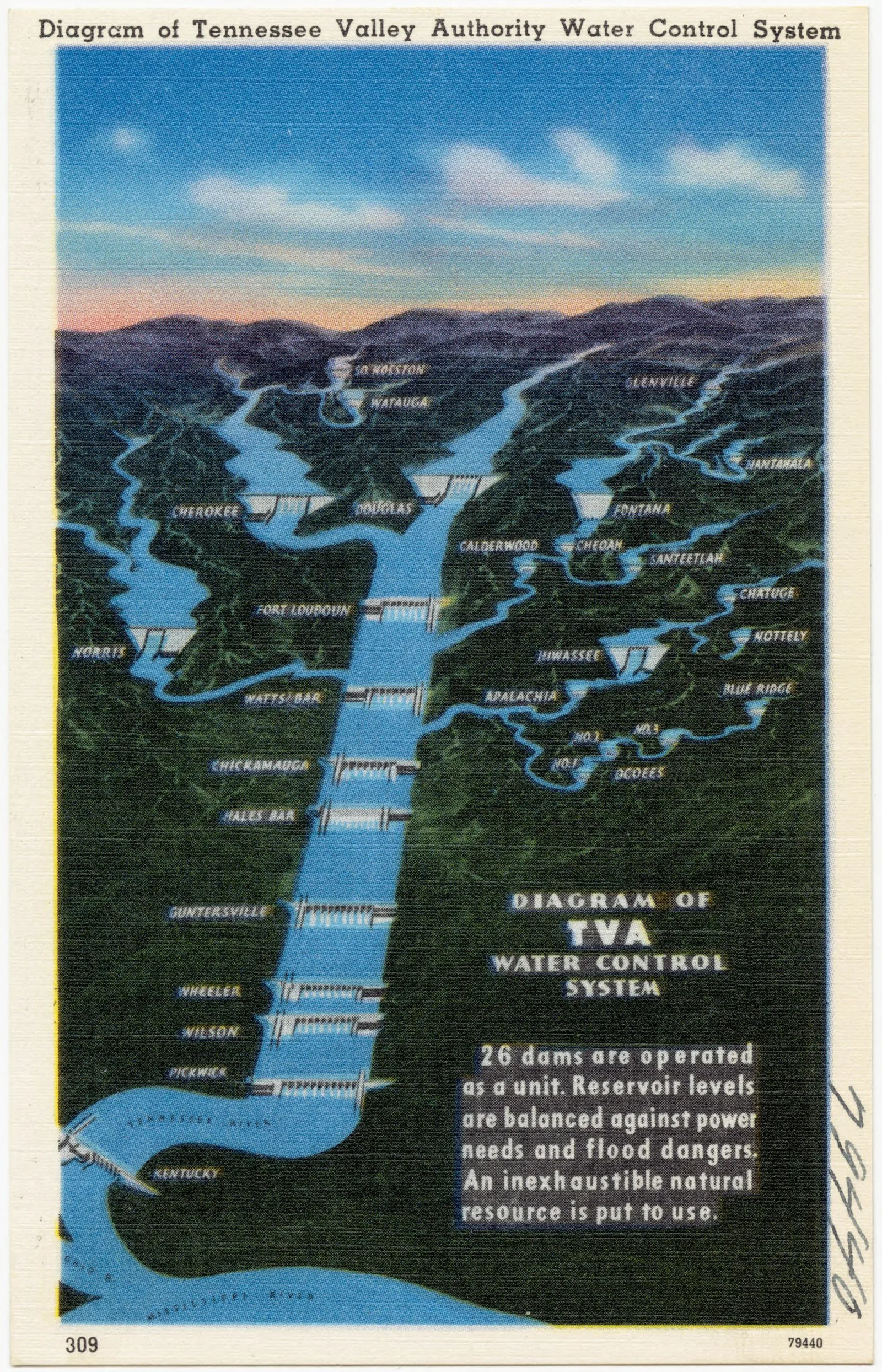
Created by the Tennessee Valley Authority Act of 18 May 1933 as a federally owned corporation, the TVA was charged with developing the Tennessee River basin across seven states. A three-member board, in which David E. Lilienthal became the dominant figure, directed an integrated programme of dam construction for flood control and navigation, hydroelectric generation distributed through municipal utilities and rural cooperatives, soil conservation, reforestation and agricultural reform. Rather than treating these as separate projects, the TVA coordinated them through unified basin-wide planning tied to the welfare of the region's population, combining engineering works with social and economic development under a single regional authority answerable to the federal government.
Significance
The TVA was the first large regional-planning agency of the United States federal government and remained its largest. Its model of a multi-purpose authority governing an entire river basin influenced New Deal regionalism and, under Lilienthal, became the global reference for postwar efforts to modernise agrarian economies, inspiring basin authorities and supra-regional development schemes across Asia, Africa and Latin America for decades.
What became of it
Realised and enduring: the TVA became a permanent federal corporation, building dams for flood control, navigation and power, and still operates today as the largest US public power provider.
Critique
Critics argue the programme's modernist faith in expert-led regional planning masked the forced displacement of valley communities and the uneven distribution of benefits.
What shaped it
- The New Deal and the Tennessee Valley Authority (1933 onward)
- Cities in Evolution (1915)
Plans it influenced
- Moscow General Plan (1935)
- Greater London Plan (1944)
Sources
- https://www.archives.gov/milestone-documents/tennessee-valley-authority-act
- https://www.britannica.com/money/Tennessee-Valley-Authority
- https://en.wikipedia.org/wiki/Tennessee_Valley_Authority