Trowulan
Core idea
Chessboard capital of perpendicular canals, reservoirs and walled compounds serving the Majapahit court
Why it matters
The only surviving urban centre of Indonesia's classical Hindu-Buddhist era and a rare planned tropical water-city
Description
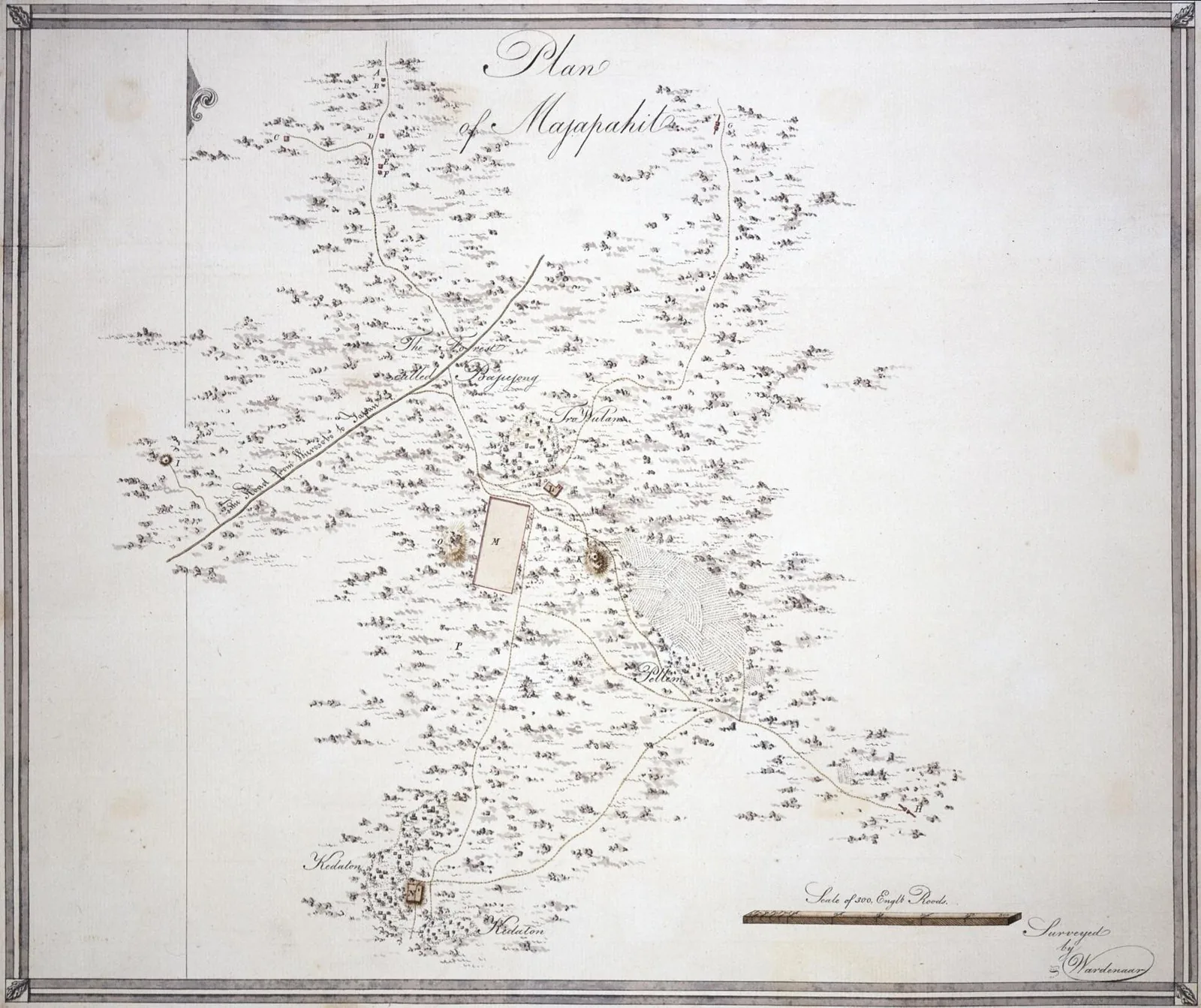
Spread across the lowlands of east Java near Mojokerto, Trowulan is identified as the capital of the Majapahit empire, founded by Raden Wijaya around 1293 and at its height in the fourteenth century. Archaeological survey has revealed a settlement laid out on a chessboard pattern of canals running north–south and east–west, dividing the city into rectangular compounds of brick walls, gateways, bathing places and temples. A network of some eighteen dams and reservoirs channelled water from the volcanic uplands for irrigation, drainage and flood control. Brick foundations, terracotta industry and the Segaran tank attest to a dense, hydraulically engineered court city.
Significance
Trowulan is the principal physical record of Majapahit, the maritime empire that once dominated the archipelago, and the only substantial urban survival from Indonesia's classical age. Its disciplined grid of canals and reservoirs demonstrates sophisticated tropical water management and a deliberate planned order centuries before European colonisation, offering a benchmark for indigenous Southeast Asian urbanism and a reference for Indonesia's contemporary capital-building debates.
What became of it
Abandoned after Majapahit's decline in the late 15th–16th century and never reoccupied as a city; today an archaeological site (UNESCO tentative list) of scattered brick ruins, gates, reservoirs and canal traces under farmland and modern villages.
Critique
Henry Maclaine Pont's influential 1920s grid-and-canal reconstruction has been criticised as pseudoarchaeology, blending observation with imagination and including spurious reservoir identifications that distorted later Trowulan scholarship.
What shaped it
- The grid (c. 2500 BCE)
- Vastu Shastra / Mayamata / Manasara (c. 6th c. CE)
- Temple-tank and eri (tank) irrigation hydraulics (c. 9th c. CE onward)
- The vastu-purusha mandala diagram (c. 6th c. CE (codified))