Ur (Third Dynasty)
Core idea
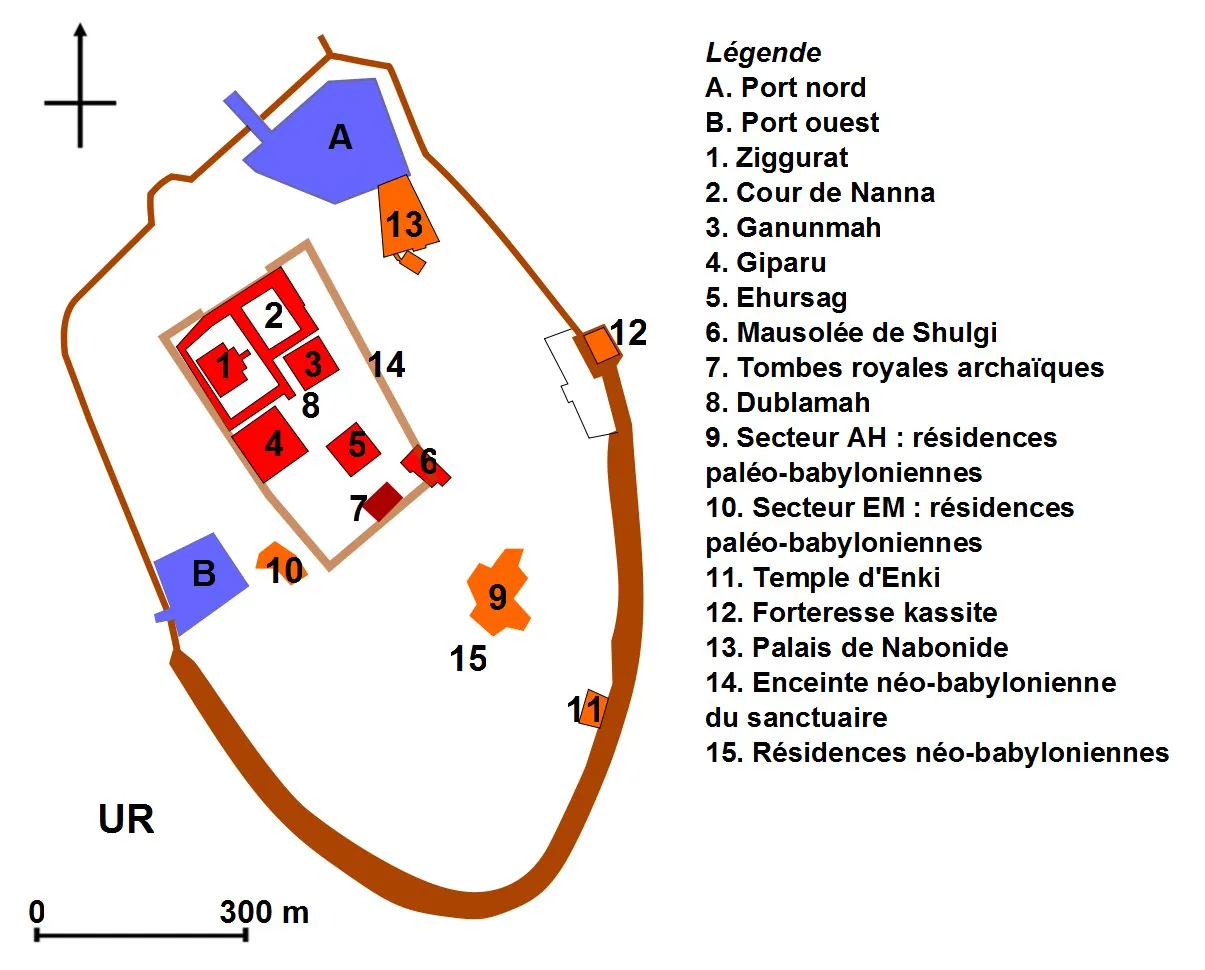
Walled city around the Great Ziggurat of Ur, with harbor, temple precinct, and planned residential quarters of courtyard houses
Why it matters
Among the best-preserved Sumerian cities; the ziggurat-and-precinct model defined Mesopotamian sacred urbanism for two millennia
Description
Ur, rebuilt under King Ur-Nammu and his successors of the Third Dynasty from around 2100 BCE, was a walled Sumerian capital on a former channel of the Euphrates in southern Mesopotamia, in present-day Iraq. The city centred on the Great Ziggurat of Ur and its raised temple precinct dedicated to the moon god Nanna, with harbours connecting the city to river and Gulf trade and residential quarters of courtyard houses along narrow streets. Excavations by Leonard Woolley in the 1920s and 1930s revealed the precinct, housing and royal tombs in exceptional detail.
Significance
Ur is among the best-preserved Sumerian cities and the clearest surviving expression of the ziggurat-and-precinct model, in which a monumental sacred core dominates and organises the surrounding urban fabric. That model defined Mesopotamian sacred urbanism for roughly two millennia, and Woolley's excavations made Ur foundational to modern understanding of the world's earliest urban civilisation.
What shaped it
- The ziggurat / temple-platform (c. 3000 BCE)
- Sumerian city-states and kingship (c. 3000 BCE)
- The Code of Ur-Nammu (c. 2100–2050 BCE)
- Writing (cuneiform and early scripts) (c. 3200 BCE)
- The sewer / sanitary drain (c. 2500 BCE)
Plans it influenced
- Baghdad (Round City of al-Mansur) (762)
- Babylon (Neo-Babylonian) (c. 600 BCE)