Uruk
Core idea
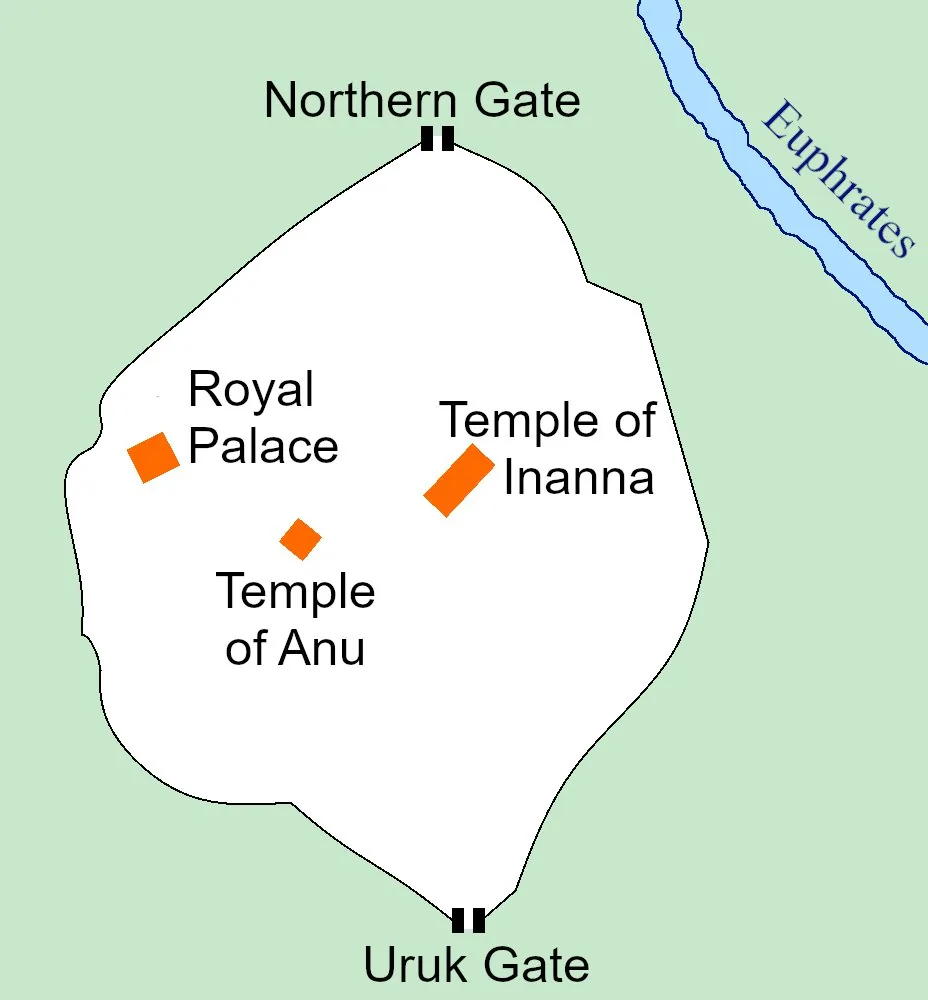
World's first true city — monumental temple precincts (Eanna, Anu ziggurat), city wall, and dense population around a sacred-administrative core
Why it matters
The origin point of urbanism itself; birthplace of writing, the bureaucratic state, and monumental civic architecture
Description
Uruk grew on the floodplain of the lower Euphrates into what archaeologists regard as the world's first true city, peaking around 3200 BCE with perhaps 40,000–80,000 people behind a brick wall traditionally credited to the legendary king Gilgamesh. Its core was not a market or a fortress but a pair of monumental temple precincts — the Eanna, sacred to Inanna, and the Anu ziggurat — around which administration, craft, and storage clustered. Here the earliest known writing (proto-cuneiform) emerged as a tool of temple accounting, alongside the cylinder seal and standardized ration bowls.
Significance
Uruk is the hinge on which human settlement turned from village to civilization. It demonstrates that the first cities were organized around sacred-administrative power rather than trade or defense, and that urbanism, writing, bureaucracy, and the state were born together as a single bundle. Every later argument about what a city is for — order, surplus, memory, control — begins here.
What became of it
Continuously occupied and rebuilt for over three millennia, its monumental Eanna and Anu precincts altered repeatedly; declined under the Seleucids/Parthians and was gradually abandoned by the early centuries CE, leaving an extensive tell.
Critique
Population figures rest on contested density-extrapolation from surface survey rather than excavated house counts, so peak estimates vary by a factor of two or more.
What shaped it
- The Neolithic Revolution (c. 9500 BCE onward)
- Agriculture and the Neolithic revolution (from c. 9500 BCE)
- Writing (cuneiform and early scripts) (c. 3200 BCE)
Plans it influenced
- Ur (Third Dynasty) (c. 2100 BCE)
- Babylon (Neo-Babylonian) (c. 600 BCE)