Vienna Ringstraße
Core idea
Fortifications replaced by cultural boulevard
Why it matters
Urban redevelopment with civic anchors
Description
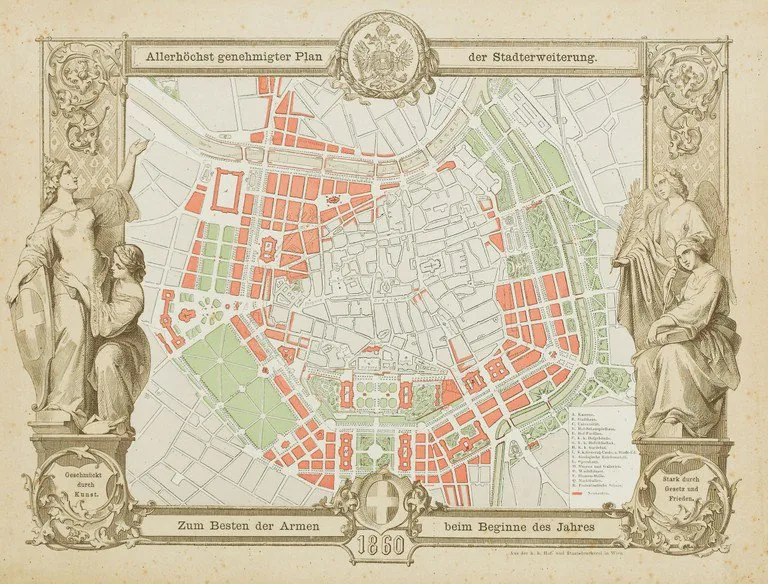
From 1857 Vienna demolished its obsolete city walls and replaced them with the Ringstraße, a grand circular boulevard lined with monumental public buildings — parliament, opera, university, city hall — set amid parks, expressing the liberal bourgeois city of institutions.
Significance
The Ringstraße is the great example of civic monumentalism as urban form, turning a defensive perimeter into a showcase of cultural and political institutions. It became a model for the representative, institution-lined boulevard worldwide.
What became of it
The medieval walls and glacis were cleared and replaced by a grand horseshoe boulevard lined with monumental historicist public buildings; it remains Vienna's defining ceremonial ring road.
Critique
Critics, notably Camillo Sitte, attacked the Ringstrasse's monumental, formally isolated set-pieces as scenographic and lacking coherent urban spatial enclosure.
What shaped it
- The boulevard (17th–19th c.)
- The public park (1843–1858)
- Nationalism (late 18th–19th c.)
Plans it influenced
- Zagreb Lenuci’s Horseshoe (1880s–1890s)
- Budapest Andrássy Avenue & Grand Boulevard (1870)
- Vienna STEP 2025 (city/region)
Sources
- https://en.wikipedia.org/wiki/Vienna_Ring_Road
- https://www.habsburger.net/en/events/ringstrasse-era-1857-1914