Zhengzhou Shang City (Shangcheng)
Core idea
Early Shang walled capital with a monumental rammed-earth circuit and zoned palace and craft quarters
Why it matters
Among the earliest large planned Chinese cities, establishing rammed-earth fortification and functional zoning
Description
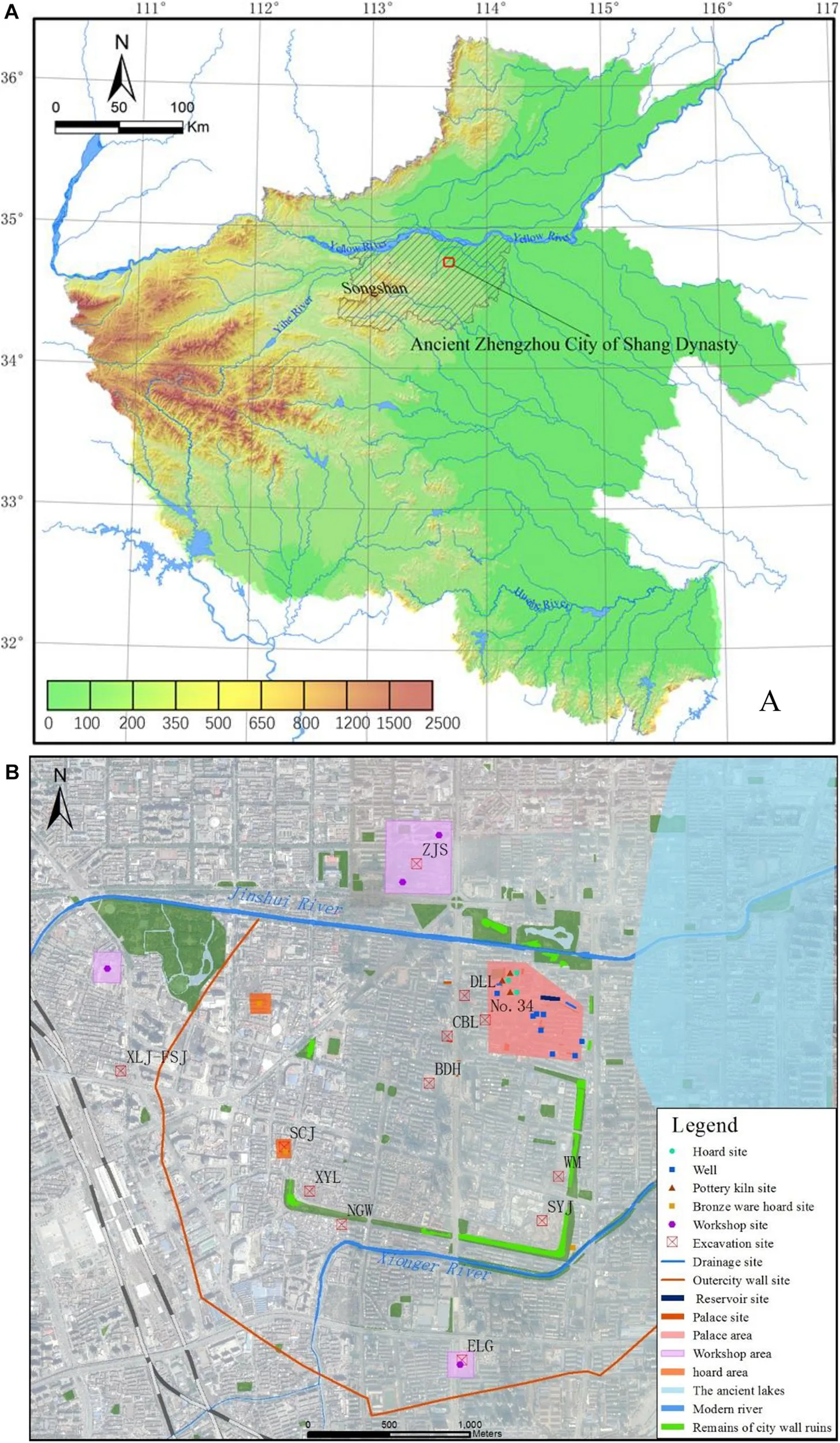
Zhengzhou Shang City is a Bronze Age walled capital of the early Shang dynasty, the type site of the Erligang culture, lying beneath modern Zhengzhou. A roughly rectangular rammed-earth inner wall ran some 7 km in circuit, around 20 m thick at the base and up to 8 m high, pierced by about eleven gaps interpreted as gates and enclosing roughly 300 hectares. Palace foundations, several with stone water features, occupied the north-east, while workshops casting bronze ritual vessels, together with bone and pottery works, storage pits, wells, dwellings and tombs, lay in the surrounding outer city, which a further enclosure may have extended considerably.
Significance
One of the earliest and largest fortified cities in China and a probable early Shang capital, Zhengzhou demonstrates monumental rammed-earth construction, deliberate zoning that separated a palace core from outlying craft quarters, and large-scale bronze production. It stands as a foundational landmark of early Chinese urbanism, prefiguring the walled, ritually ordered and functionally divided capitals that would define the imperial tradition that followed.
What became of it
Major early Shang walled capital (often identified with Ao/Bo); its massive rammed-earth walls were realised and the city thrived before the centre of power shifted, leaving the ramparts partly preserved beneath modern Zhengzhou.
Critique
The site's identification with a specific named Shang capital and its precise chronology relative to Yanshi/Erlitou remain contested among Chinese archaeologists.
What shaped it
- The grid (c. 2500 BCE)
- Sumerian city-states and kingship (c. 3000 BCE)
- Writing (cuneiform and early scripts) (c. 3200 BCE)
Plans it influenced
- Anyang / Yin (Yinxu, Shang Capital) (c. 1250 BCE)
- Linzi (Qi State Capital) (c. 859 BCE)
- Chengdu (Qin Planned City) (c. 311 BCE)