Constantinople (Byzantine)
Core idea
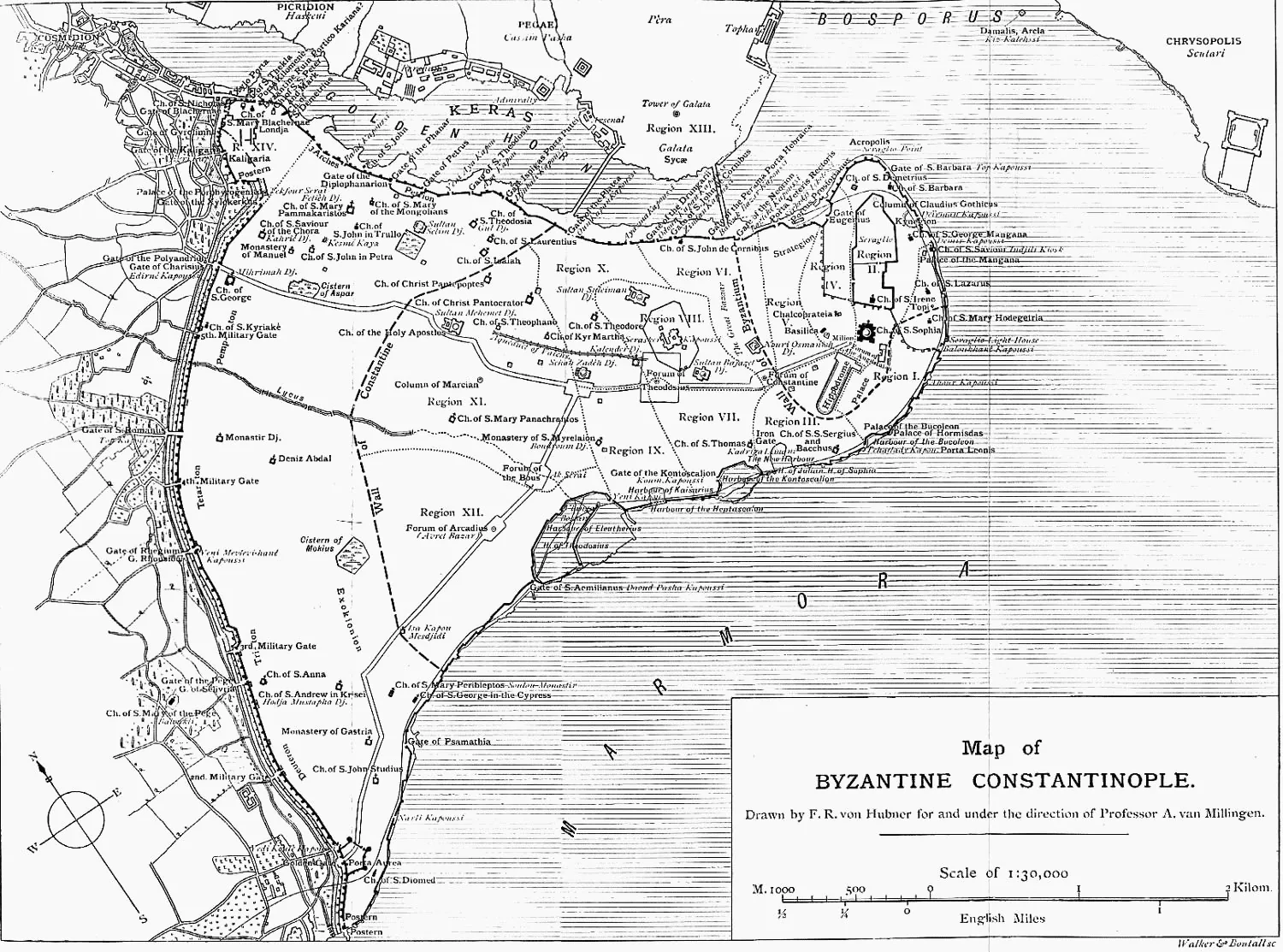
Refounded imperial capital on the Bosphorus — fora linked by the Mese avenue, Hagia Sophia, Hippodrome, vast cisterns, and the triple Theodosian Walls
Why it matters
The bridge between ancient and medieval urbanism; its walls, water infrastructure, and monumental armature made it the largest city in the medieval world for centuries
Description
Constantine refounded the Greek town of Byzantium as his eastern capital in 330 CE, and over the following century it acquired the armature of a great imperial city: monumental fora linked by the colonnaded Mese avenue, the Hippodrome, the church of Hagia Sophia, vast underground cisterns, and — under Theodosius II — the triple line of land walls that made it nearly impregnable for a thousand years.
Significance
Constantinople is the bridge between ancient and medieval urbanism. It carried Roman infrastructure, monumental planning, and engineering into the medieval world and remained the largest, richest city in Europe and the Near East for centuries. Its walls, water systems, and ceremonial spine influenced both Islamic and European capitals that followed.
What became of it
Refounded by Constantine in 330 CE and realised as the imperial capital, it grew far beyond its original circuit, requiring the Theodosian Walls; it remained the Byzantine capital until 1453 and survives, transformed, as Istanbul with monuments such as Hagia Sophia and the Hippodrome.
Critique
The peak-population figures are disputed: critics note the canonical ~500,000 rests on indirect proxies (grain doles, wall circuit) rather than direct census data, so estimates carry large uncertainty.
What shaped it
- The Roman Republic and Empire (509 BCE – 476 CE)
- The plaza / forum / agora (c. 500 BCE)
- The aqueduct (c. 700 BCE)
- Founding of Constantinople (330 CE)
- The Roman arch, vault, dome and concrete (developed from c. 3rd century BCE)
Plans it influenced
- Córdoba (Umayyad Caliphate) (c. 756–1031)
- Cairo (Fatimid al-Qahira) (969)
- Istanbul (Ottoman / Sinan külliye urbanism) (1453–1600)