Fatehpur Sikri
Core idea
Short-lived Mughal capital synthesizing Hindu, Islamic, and Persian planning — palatial complexes, Buland Darwaza, Panch Mahal
Why it matters
Peak of Mughal syncretic urbanism; demonstrates planned capital-building as political-religious statement
Description
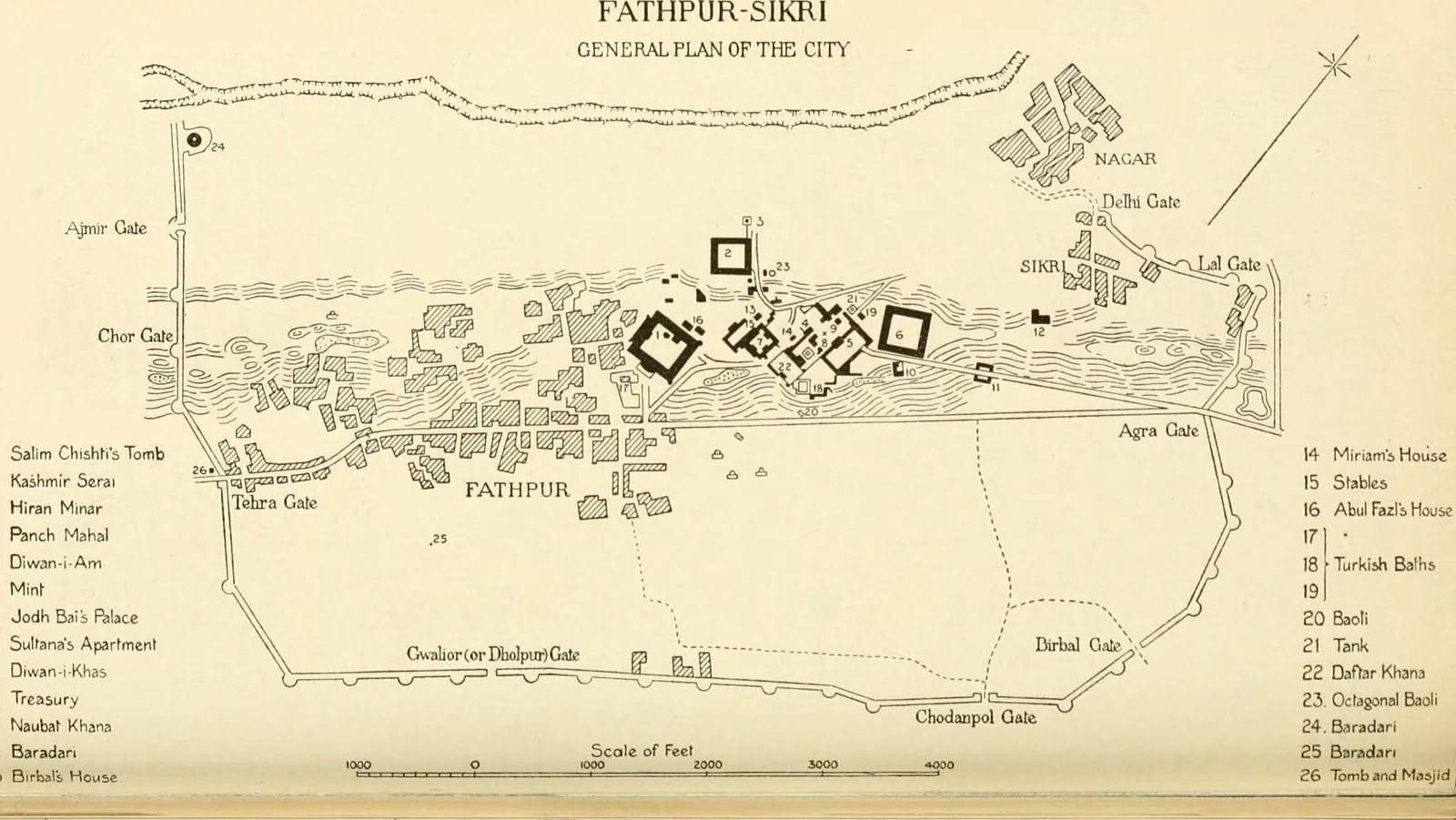
Built by the Mughal emperor Akbar between 1569 and 1585 as a new imperial capital, Fatehpur Sikri synthesized Hindu, Islamic, and Persian design into a sequence of courtyards, palaces, and the monumental Buland Darwaza gateway. Abandoned within about fifteen years — likely for want of water — it survives almost intact as a frozen Mughal city.
Significance
Fatehpur Sikri is the peak of Mughal syncretic urbanism and a vivid example of capital-building as political-religious statement. Its near-immediate abandonment makes it a haunting lesson in how even imperial cities depend on the prosaic question of water.
What became of it
Served as Akbar's Mughal capital only c.1571–1585, then largely abandoned, traditionally attributed to water shortage; the monumental core (Buland Darwaza, Panch Mahal) survives well-preserved as a 'ghost city' and UNESCO site.
Critique
Recent scholarship questions the simple 'abandoned for lack of water' narrative, arguing the move owed more to shifting political and strategic priorities, with the city never wholly deserted.
What shaped it
- Vastu Shastra / Mayamata / Manasara (c. 6th c. CE)
- The stepwell (baoli / vav) (c. 6th c. CE onward)
- Christianity & Islam (1st c. CE / 622 CE)
Plans it influenced
- Shahjahanabad (Old Delhi) (1639–1648)
- Hyderabad / Charminar (Qutb Shahi City) (1591)