Florence (Communal–Renaissance)
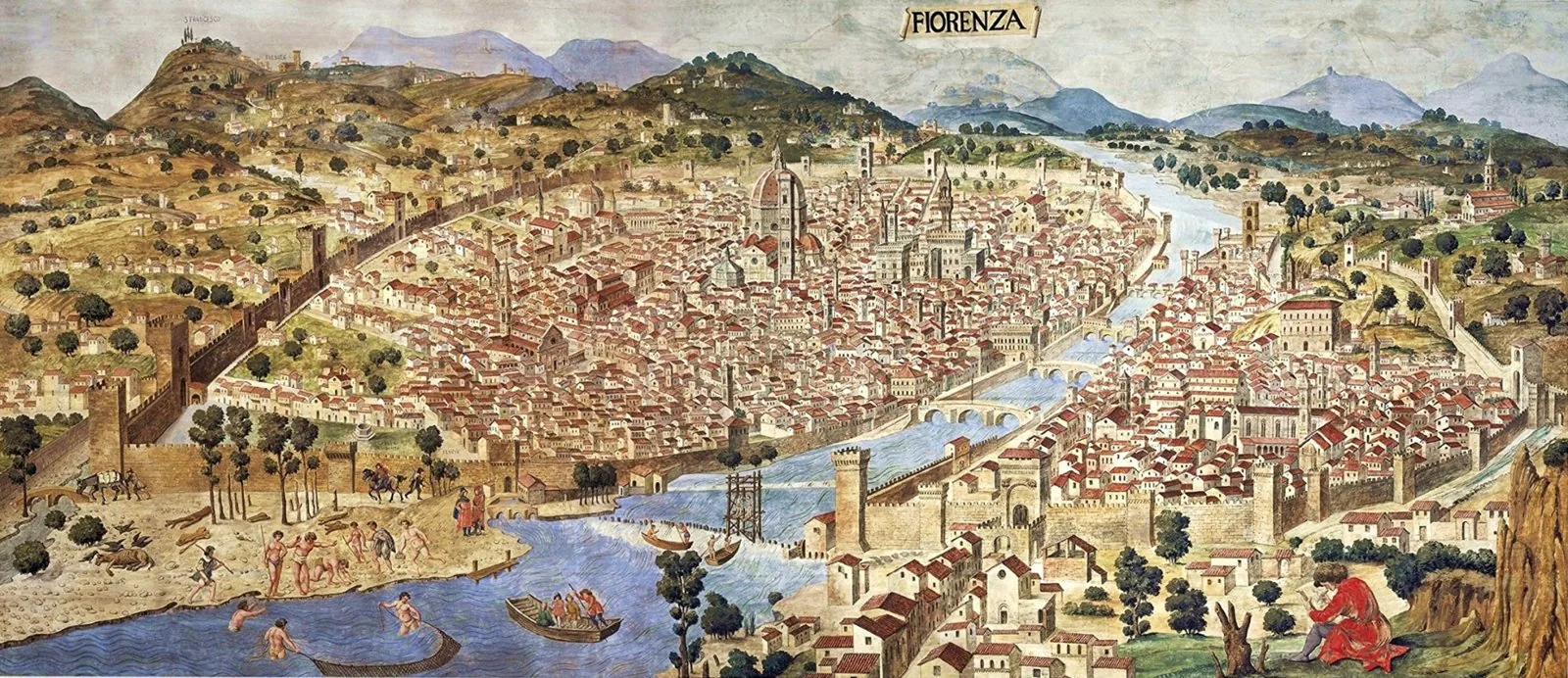
Core idea
Banking-republic city whose communal statutes regulated streets, façades, and the great civic spaces (Piazza della Signoria, the Duomo) — later the cradle of Renaissance perspective and ideal-city theory
Why it matters
Where medieval communal regulation met Renaissance design theory (Alberti, Brunelleschi); the conceptual birthplace of the planned, perspectival ideal city
Description
Florence between the late thirteenth and fifteenth centuries was shaped first by the communal government of the banking republic and later by Medici patronage. Communal statutes regulated street widths, facade lines and building conduct, while the city created its great civic spaces, the Piazza della Signoria and the cathedral complex crowned by Brunelleschi's dome. In the fifteenth century the same city nurtured Alberti's treatise, perspective drawing and the theoretical ideal city.
Significance
Florence is where medieval communal regulation met Renaissance design theory, making it the conceptual birthplace of the planned, perspectival ideal city. Its combination of legal control over urban form and humanist theorising influenced European urbanism for centuries, and it remains central to debates on the relationship between civic power, capital and the shaping of cities.
What became of it
The communal-Renaissance city was largely realised as planned and its core survives - the line of the Arnolfo walls, the centro storico and the Piazza della Signoria remain; the 14th-century walls were mostly demolished in the 1860s under Giuseppe Poggi when Florence briefly became capital of Italy, and the population was roughly halved by the 1348 Black Death.
Critique
The republic's communal statutes regulating streets and facades are sometimes critiqued as serving the self-image and oligarchic control of the banking elite as much as genuine public welfare.
What shaped it
- Aquinas and scholasticism (13th c.)
Plans it influenced
- Rome Sixtus V Plan (1585–1590)
- Palmanova (1593)
- Siena (c. 1290)