Palmanova
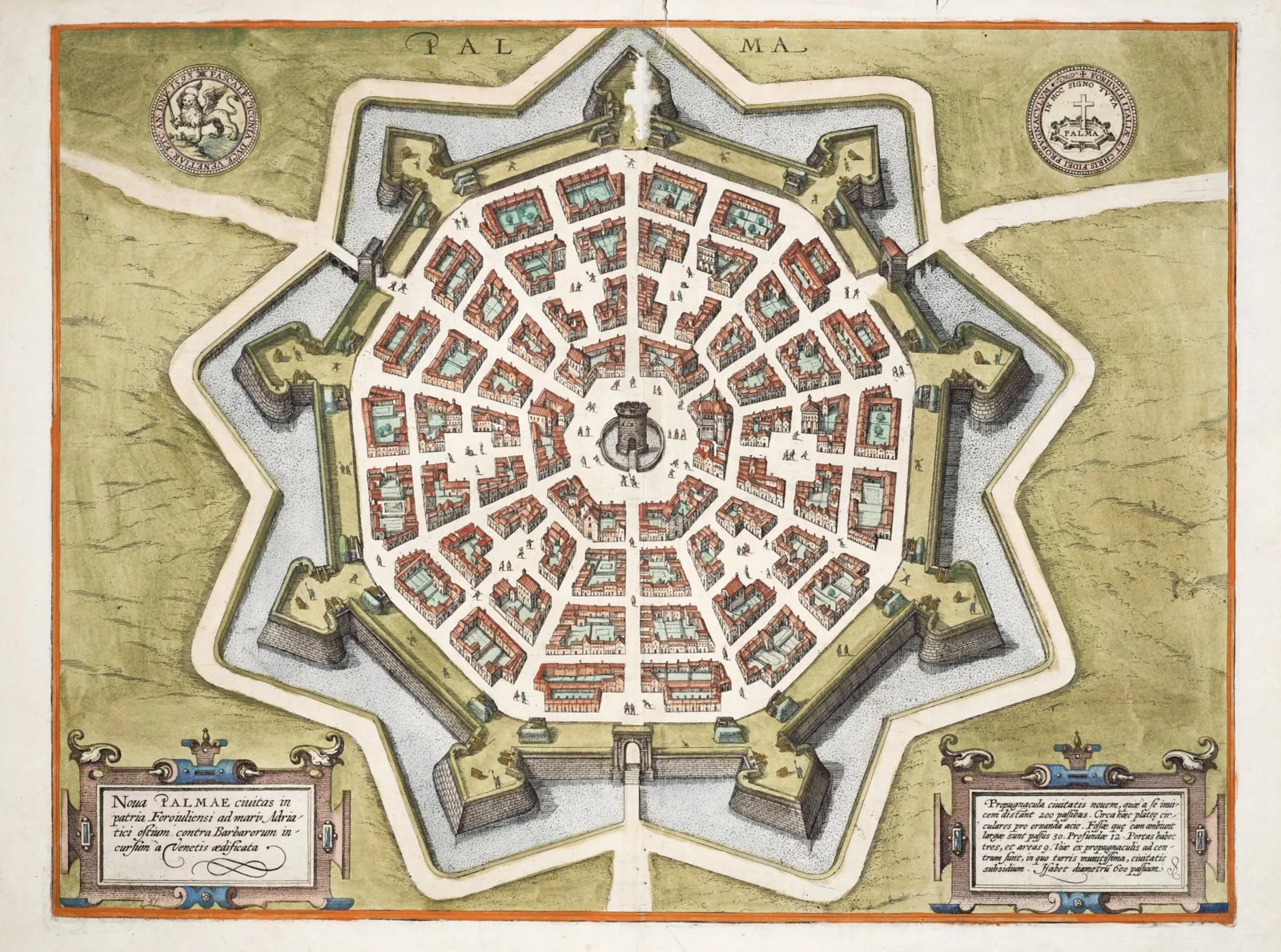
Core idea
Ideal star-fort geometry
Why it matters
Peak of Renaissance ideal-city tradition
Description
Built by the Venetian Republic from 1593, Palmanova is the purest realized Renaissance ideal city: a nine-pointed star fort with a perfectly radial-concentric street plan converging on a central hexagonal piazza. Military geometry and humanist theory fused into a single diagram designed to be both defensible and rationally beautiful.
Significance
Palmanova is the textbook 'ideal city' made real — the star-fort that married Renaissance design theory to gunpowder-age fortification. It crystallizes the dream of the city as a perfect geometric object, influential far beyond its modest size.
What became of it
Realised as an ideal nine-pointed star fortress and still intact as a UNESCO-listed town, but it never attracted its intended population and remains a small, sparsely settled community.
Critique
The rigid military geometry proved economically unattractive, so the ideal city was never populated as planned.
What shaped it
- The Renaissance (14th-16th c.)
- De Re Aedificatoria (1452)
- Sforzinda (Trattato di architettura) (c. 1465)
- Gunpowder and the cannon (9th–14th c.)
Plans it influenced
- St. Petersburg (1716)
- Mannheim Quadratestadt (1606)
- Batavia (Old Jakarta) VOC Grid & Canal City (1619)
Sources
- https://en.wikipedia.org/wiki/Palmanova
- https://www.heritagedaily.com/2022/03/the-palmanova-star-fort/143256