Madras / Fort St George & the Colonial Grid
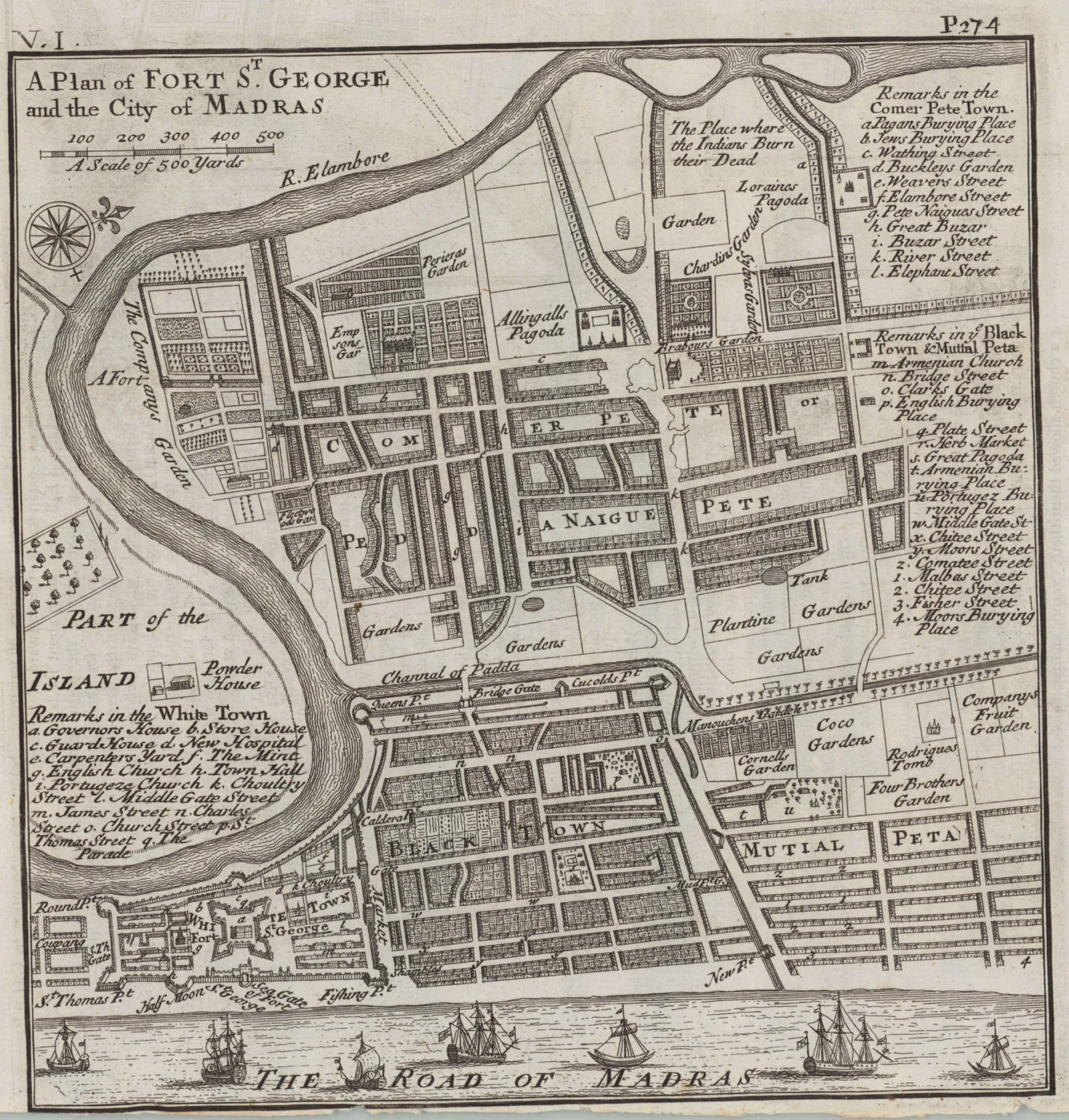
Core idea
First English fortress-town in India, pairing a gridded White Town with an adjacent Black Town.
Why it matters
Established the dual-city colonial template that seeded modern Chennai and later British India.
Description
Fort St George was begun in 1640 by Francis Day and Andrew Cogan of the English East India Company on a strip of the Coromandel coast acquired the previous year from the Raja of Chandragiri. Completed around 1644, it was the first English fortified settlement in India. Within its walls lay the gridded 'White Town', the residence and warehouses of the Company's European staff, while to the north grew the indigenous 'Black Town' (Chennapatnam) of weavers, dyers and traders. Together fort, White Town and Black Town formed early Madras, a segregated dual settlement whose ordered enclave and sprawling native quarter became the model from which the colonial metropolis of Chennai subsequently expanded.
Significance
Fort St George inaugurated the British colonial city in India and crystallised the racially segregated 'White Town / Black Town' model that recurred across Company settlements. Its fortified, gridded European core set against an organic indigenous quarter shaped later urban policy in Madras, Calcutta and Bombay. The fort survives as the administrative heart of Tamil Nadu, a tangible origin point for one of South Asia's major cities.
What became of it
Realised as the first English fortress-town in India and the nucleus of Chennai; Fort St George survives and still houses the Tamil Nadu government, while the adjacent Black Town was repeatedly rebuilt and absorbed into the wider city.
Critique
The fort institutionalised racial segregation through its paired White Town and Black Town.
What shaped it
- The British Empire and modern colonialism (1600 – 20th c.)
- The grid (c. 2500 BCE)
- Ottoman, Mughal and Qing imperial states (16th–18th c.)
- The Atlantic slave trade (16th–19th c.)
- Ocean-going caravel, galleon and navigation (15th–16th c.)
Plans it influenced
- Pondicherry (Puducherry) Dual City (1674–1954)
- Shanghai Foreign Settlement & the Bund (1845)
- Raffles Town Plan of Singapore (Jackson Plan) (1822)