McMillan Plan (Senate Park Commission), Washington, D.C.
Core idea
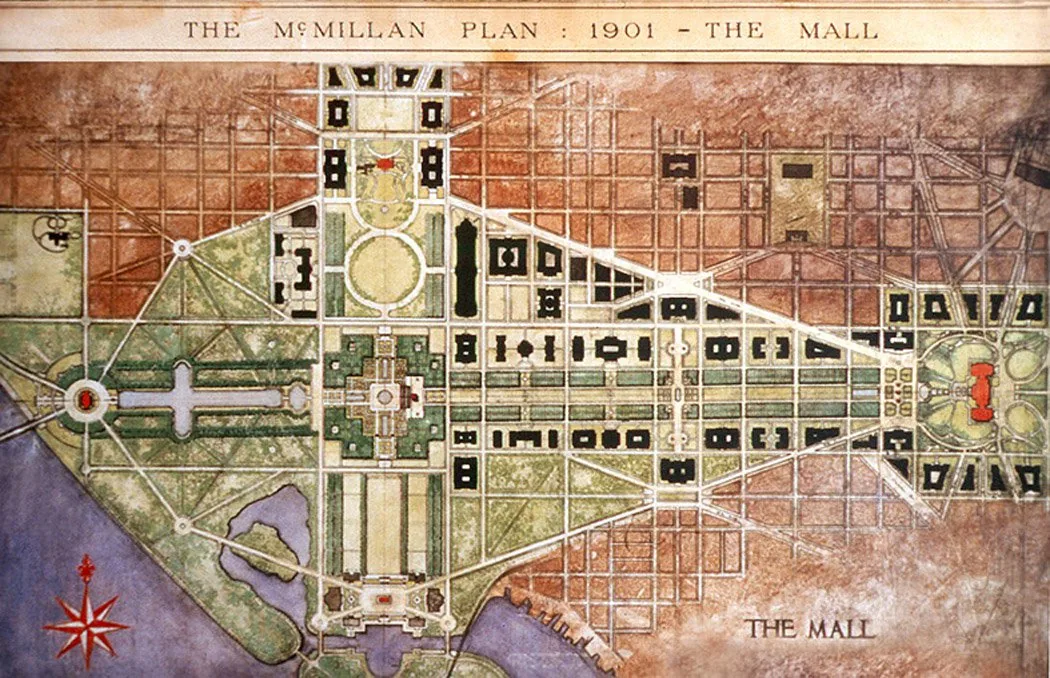
Beaux-Arts monumental plan reordering Washington's National Mall on formal axes.
Why it matters
The City Beautiful movement's defining national commission.
Description
The McMillan Plan was prepared in 1902 by the Senate Park Commission, established by the United States Senate in 1901 at the instigation of Senator James McMillan. Its members—architect Daniel Burnham, landscape architect Frederick Law Olmsted Jr., architect Charles F. McKim and sculptor Augustus Saint-Gaudens—had largely worked on the 1893 World's Columbian Exposition. The plan revived and extended Pierre Charles L'Enfant's scheme, clearing the Victorian planting of the National Mall to create a broad cruciform expanse of grass framed by elms, lined with neoclassical museums and cultural buildings, and terminated by monumental memorials. It also proposed parks, civic buildings and a coordinated park system for the capital.
Significance
The McMillan Plan was the founding monumental work of the American City Beautiful movement, translating Beaux-Arts ideals of axial order and civic grandeur into the symbolic landscape of the national capital. It set the template for the Mall as realised through the twentieth century and established a model of comprehensive civic design that shaped subsequent City Beautiful schemes across the United States and its colonial possessions.
What became of it
Though never formally adopted as a whole, many recommendations were realised piecemeal, mostly before the Second World War, including clearance of slums and railway tracks near the core and the westward extension of the Mall anchored by the Lincoln Memorial. It continues to shape Washington's monumental core.
Critique
Its Beaux-Arts monumentality came at the cost of clearing existing neighbourhoods and imposing a rigid formal order on the capital.
What shaped it
- City Planning According to Artistic Principles (1889)
- The public park (1843–1858)
- The boulevard (17th–19th c.)
- World's Columbian Exposition (1893)
Plans it influenced
- Chicago Plan of 1909 (1909)
- Canberra (1913)
- Cleveland Group Plan of 1903 (1903)
- Burnham Plan of Manila (1905)
Sources
- https://en.wikipedia.org/wiki/McMillan_Plan
- https://www.senate.gov/artandhistory/senate-stories/a-capital-plan.htm