Barlow Report — Royal Commission on the Distribution of the Industrial Population
Core idea
Royal Commission report diagnosing industrial over-concentration and recommending planned decentralisation of industry and population
Why it matters
Founding charter of British regional policy, leading directly to the new towns and postwar planning legislation
Description
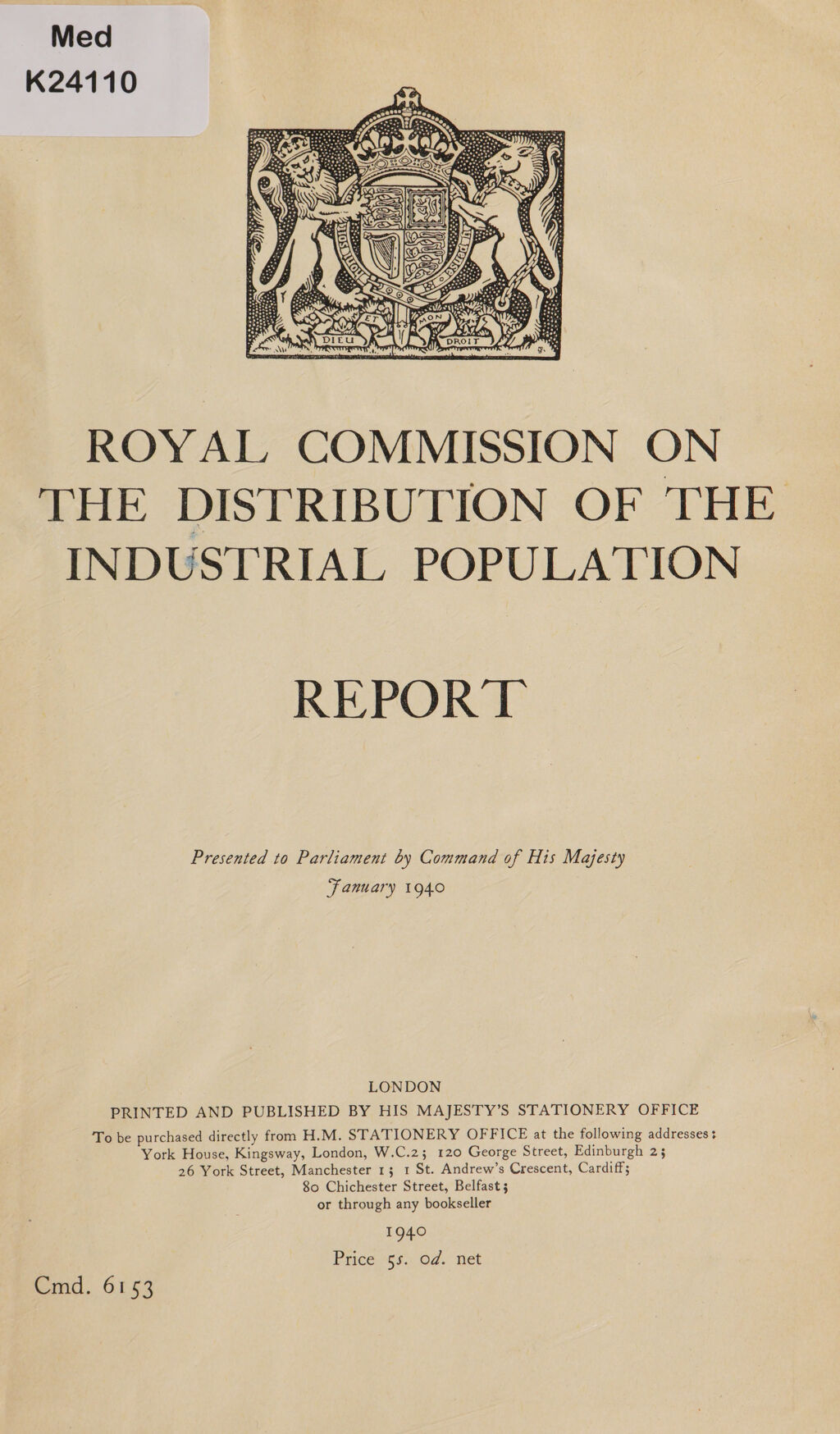
Appointed by Royal Warrant in 1937 and chaired by Sir Anderson Montague-Barlow, the Royal Commission on the Distribution of the Industrial Population reported in January 1940. It examined the concentration of industry and population, especially light industry and trade around London, against the decline of older industrial regions. The report concluded that this geographical imbalance carried social, economic and strategic disadvantages, and recommended 'planned decentralisation' of industry and people, the control of further metropolitan growth, and the creation of a central authority to oversee the location of industry nationally. It reframed industrial location as a matter for deliberate national spatial policy rather than market drift.
Significance
Though largely overlooked on publication amid the outbreak of war, the Barlow Report became the founding charter of British regional and town planning. Its decentralisation logic underpinned the 1945 Distribution of Industry Act, the 1946 New Towns Act and the 1947 Town and Country Planning Act, shaping green belts, new towns and the postwar settlement of England for a generation.
What became of it
Initially shelved on publication (January 1940) amid the war, but its diagnosis and call for planned decentralisation became a foundation for post-war planning, the 1947 planning system and the New Towns movement.
Critique
Critics note the report diagnosed concentration vividly but its remedies were cautious and lacked binding enforcement mechanisms, leaving implementation to later legislation.
What shaped it
- Garden Cities of To-Morrow (1898 / 1902)
- The green belt (1898 concept / 1938 law)
- Keynesian economics (1936)
- Cities in Evolution (1915)
Plans it influenced
- Greater London Plan (1944)
- Harlow New Town (1947)
- County of London Plan (1943)
Sources
- https://www.designingbuildings.co.uk/wiki/Barlow_Report
- https://en.wikipedia.org/wiki/Anderson_Montague-Barlow
- https://academic.oup.com/jrsssa/article/103/3/323/7096602