Neues Frankfurt (New Frankfurt) — Römerstadt and the May Siedlungen
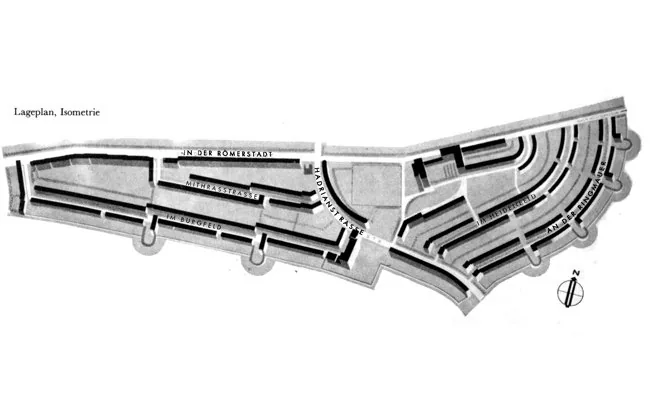
Core idea
Municipal functionalist housing programme delivering standardised Existenzminimum dwellings at city scale.
Why it matters
Showed that rationalised, prefabricated mass housing could be organised as comprehensive public policy.
Description
Neues Frankfurt was a public-housing programme initiated in 1925 after mayor Ludwig Landmann appointed Ernst May as the city's building councillor. Between 1925 and 1930 it produced roughly 12,000 dwellings across peripheral estates including Römerstadt, Praunheim, Westhausen and Bruchfeldstraße. The estates applied functionalist principles: row blocks oriented for sunlight and ventilation, generous communal green space drawn from garden-city models, and standardised prefabricated components to lower costs. Dwellings were designed to the Existenzminimum, the minimum subsistence standard, and equipped with the rationalised, fitted Frankfurt Kitchen devised by Margarete Schütte-Lihotzky. The programme integrated planning, construction, interior fittings and publication into a single coordinated municipal apparatus.
Significance
Neues Frankfurt demonstrated that the abstractions of the Modern Movement could be realised at scale as coordinated public policy rather than as isolated demonstration buildings. Its standardisation, prefabrication and the mass-produced Frankfurt Kitchen carried the Existenzminimum debate from theory into tens of thousands of occupied homes, and it became a touchstone for interwar social housing and for the CIAM discussions on minimum dwellings that followed.
What became of it
Largely realised as a municipal housing programme delivering thousands of standardised Existenzminimum dwellings, including the Romerstadt estate; the programme wound down after 1930 and Ernst May left for the Soviet Union in 1930.
Critique
The minimum-dwelling standard prioritised efficiency and economy, producing very small flats that critics found cramped.
What shaped it
- Garden Cities of To-Morrow (1898 / 1902)
- The superblock (1920s–30s / 2016 revival)
- Marx & socialism (1848 / 1867)
- The garden suburb (1903)
- Housing & Town Planning Act (1909)
Plans it influenced
- Amsterdam AUP (Algemene Uitbreidingsplan) (1935)
- Kraków Nowa Huta (historic plan) (1949)
- Weissenhofsiedlung (Die Wohnung exhibition estate) (1927)
- The Athens Charter (CIAM IV, the Functional City) (1933 (published 1943))
- Milyutin's Sotsgorod and the Magnitogorsk linear-city debates (1930)
Sources
- https://en.wikipedia.org/wiki/New_Frankfurt
- https://bauhauskooperation.com/knowledge/the-bauhaus/works/architecture/dessau-toerten-housing-e