Bogotá POT (2000/2021)
Core idea
Polycentricity with BRT/TOD
Why it matters
Latin American model of transit-led form
Description
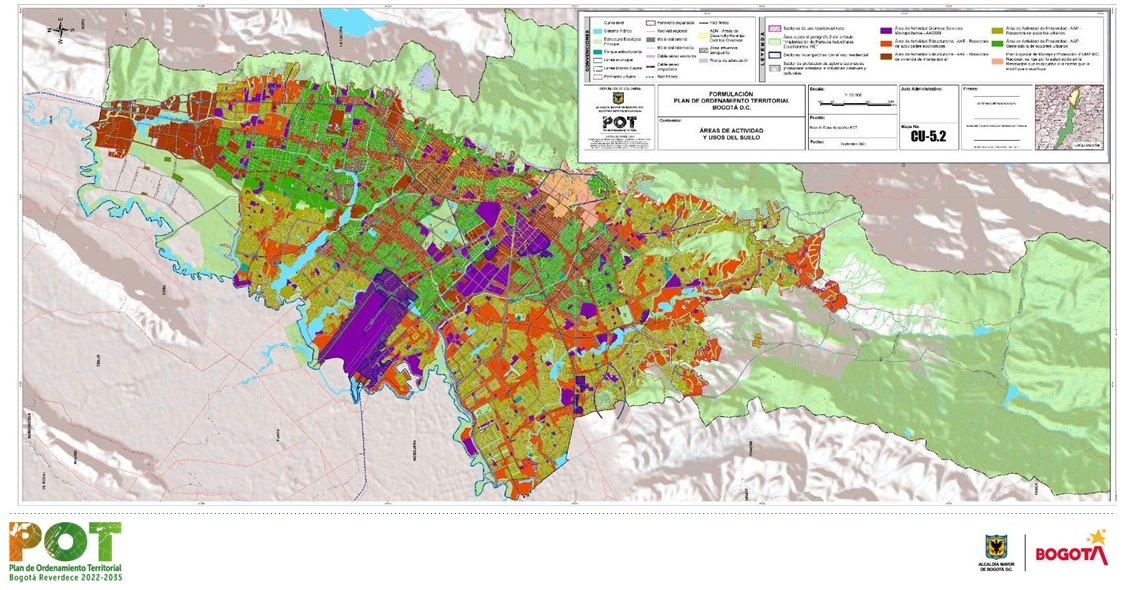
Bogotá's Plan de Ordenamiento Territorial (2000, revised 2021) set a long-range framework pairing compact growth with social equity, supporting the TransMilenio BRT, an expanded bikeway network, and parks under the influential 'social urbanism' agenda of mayors Peñalosa and Mockus.
Significance
Bogotá's POT and its era of reform became a Global South reference for equity-driven mobility planning, showing how bus rapid transit, cycling, and public space can prioritize the majority who do not drive.
What became of it
The 2000 POT (Decree 619), revised in 2003 (Decree 469) and compiled as Decree 190 of 2004, governed Bogota for nearly two decades; after annulled or rejected revision attempts in 2013 and 2019, a new POT 'Bogota Reverdece 2022-2035' was adopted by decree (Decree 555) in 2021.
Critique
Analysts note the plan's polycentric and TOD ambitions were repeatedly undercut by legal challenges and by over-reliance on TransMilenio bus rapid transit rather than a genuinely multimodal regional network.
What shaped it
- Bus Rapid Transit (BRT) (1974)
- Transit-oriented development (TOD) (1993)
- The compact city (1973-1990s)
- Le Droit a la ville (Lefebvre) (1968)
Plans it influenced
- Medellín PUI & MetroCable (2004–)
- Johannesburg SDF 2040 (2016)
- Bogotá Regiotram & Metro Expansion Plans (2016–)
- Cali MIO Integrated Mobility Plan (2002–)
- Buenos Aires MobiPlan & Green Corridors (2013–)
- Fortaleza Bicicleta Integrada & Transit Plan (2014–)
Sources
- https://www.eltiempo.com/bogota/analisis-a-lo-que-se-logro-con-el-pot-del-2000-en-bogota-94214
- https://www.probogota.org/que-hacemos/datos-y-analisis/pot-plan-de-ordenamiento-territorial-de-b