Hammarby Sjöstad (Stockholm)
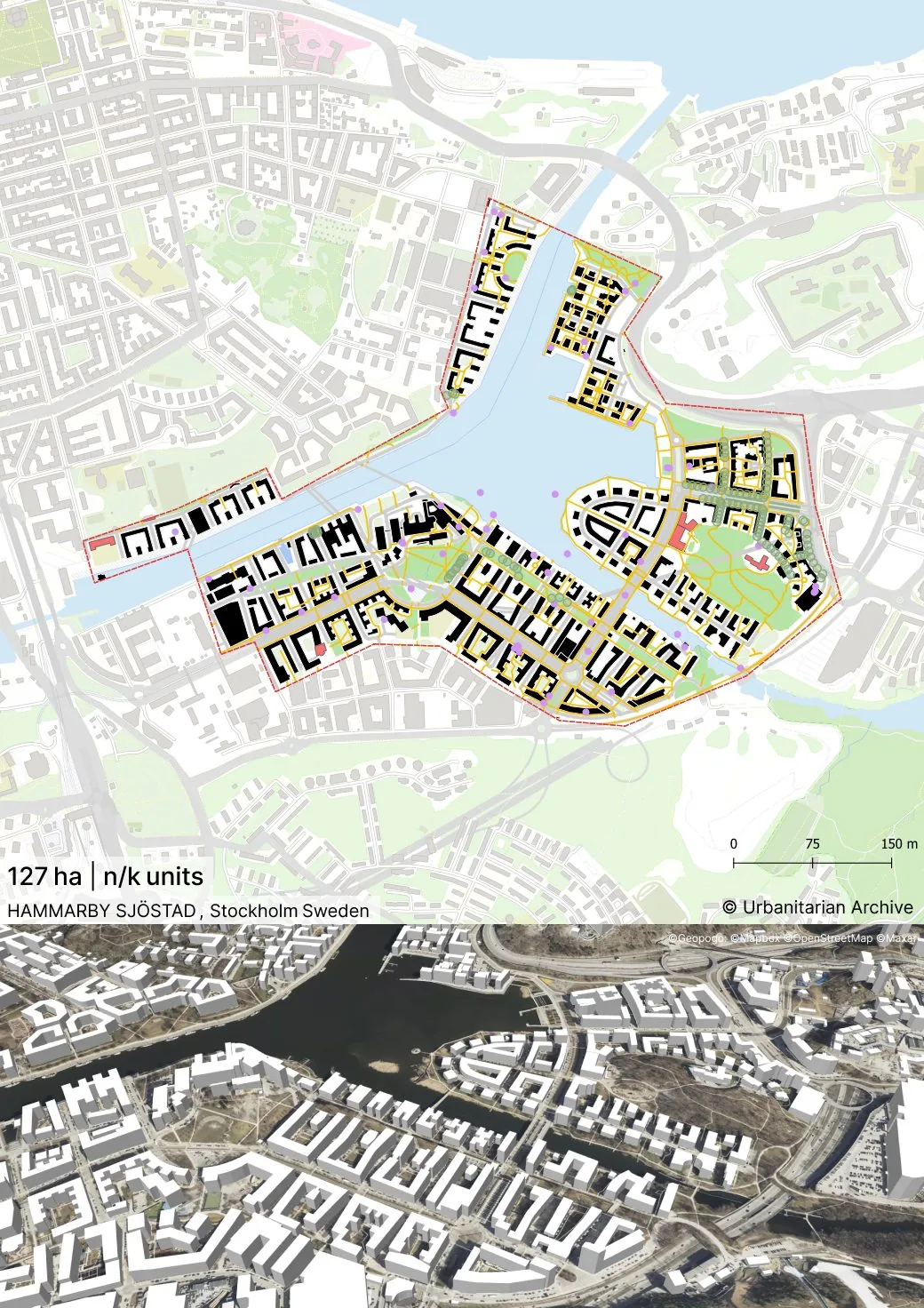
Core idea
Eco-district with closed-loop systems
Why it matters
Pioneer of urban eco-technology integration
Description
Stockholm's Hammarby Sjöstad (1990s) redeveloped a former industrial harbour as a dense, mixed-use eco-district built around the 'Hammarby model' — an integrated closed loop of energy, waste, water, and transit designed to halve environmental impact.
Significance
Hammarby Sjöstad became one of the most studied and visited eco-districts in the world, demonstrating integrated, systems-based sustainable urban design at neighbourhood scale and influencing eco-city projects globally.
What became of it
Built in phases from the mid-1990s to around 2020 on a former brownfield, the eco-district was substantially realised close to its planned scale (~11,000 homes, ~25,000 residents) and became an internationally cited model for closed-loop (Hammarby Model) urban metabolism.
Critique
Scholars argue it prioritised technological and aesthetic 'eco' branding over deeper social sustainability, missing some energy targets and gentrifying into an affluent, homogeneous neighbourhood rather than the mixed-tenure community intended.
What shaped it
- Sustainable development (Brundtland) (1987)
- Rio Earth Summit (1992)
- District heating (Lockport district system 1877; modern CHP networks 20th c.)
- Ecology (1866 / 1935)
- The compact city (1973-1990s)
Plans it influenced
- Changsha Meixi Lake (2009–)
- Dongtan Eco-city (unbuilt) (2005–)
- Bordeaux Bastide–Niel (2010s–)
- Freiburg Vauban (1993–)
- IBA Hamburg 2006–2013 (Wilhelmsburg etc.) (2006–2013)
- Ørestad (Copenhagen) (1992)
- HafenCity Hamburg (2000–)
- Malmö Western Harbour / Bo01 (2001–)
Sources
- https://www.envacgroup.com/insights/the-sustainable-city-the-story-of-hammarby-sjostad/
- https://smartcitysweden.com/best-practice/60/successful-renewal-from-industrial-area-to-a-model-