London Docklands Regeneration
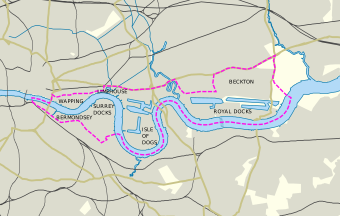
Core idea
Market-led waterfront reinvention
Why it matters
Shift to enterprise-zone redevelopment
Description
From 1981 the London Docklands Development Corporation regenerated the derelict eastern docks through a property-led, deregulated 'enterprise zone' model, catalyzing the Canary Wharf financial district and the Docklands Light Railway on former port land.
Significance
Docklands is the defining (and contested) case of property-led, market-driven waterfront regeneration, exported worldwide. It crystallized debates about who benefits when public agencies hand redevelopment to private capital.
What became of it
Realised as a market-led waterfront transformation, producing Canary Wharf, the DLR and London City Airport.
Critique
Its property-led, deregulated approach delivered little for existing low-income East End communities.
What shaped it
- Thatcher–Reagan deregulation (1979–1989)
- Neoliberalism (1970s–1990s)
- The skyscraper (1885)
- Postmodernism in architecture & planning (1977)
Plans it influenced
- King’s Cross Central (2006–)
- Rotterdam Stadshavens / M4H (2007–)
- Marseille Euroméditerranée (1995–)
- Genoa Blue District & Waterfront (2018–)
- Glasgow Clyde Waterfront Regeneration (2000s–)
- Manchester Strategic Regeneration Frameworks (2010s–)
- Birmingham Big City Plan (2010)
- Baltimore Harbor East/Harbor Point Plans (2000s–)
Sources
- https://en.wikipedia.org/wiki/London_Docklands_Development_Corporation
- https://www.liverpooluniversitypress.co.uk/doi/10.3828/tpr.62.3.j3qt6w7572484271