Dadu (Yuan Beijing)
Core idea
Orthogonal macro-grid, axial logic
Why it matters
Sets enduring north–south axis of Beijing
Description
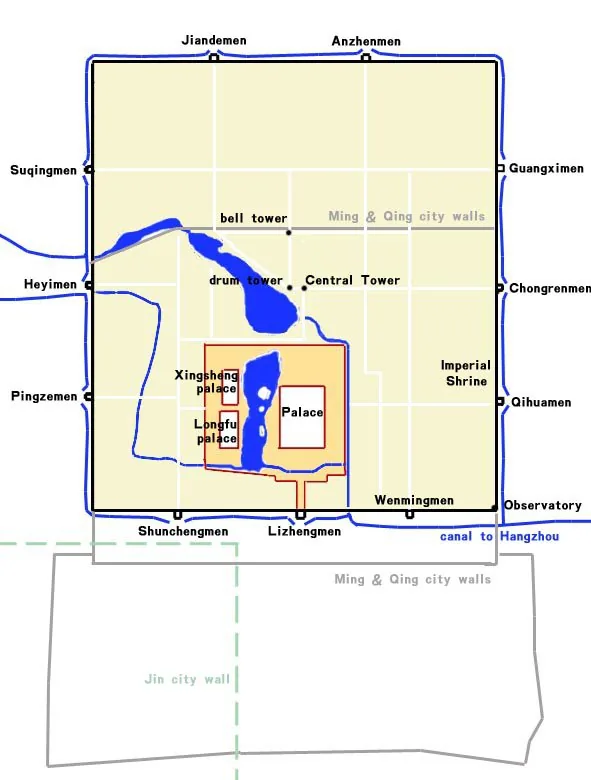
Dadu, the Yuan dynasty capital begun in 1267 on the site of present-day Beijing, was planned by Liu Bingzhong for Kublai Khan. The city was laid out as an orthogonal macro-grid of walled wards and broad avenues, structured by a dominant north-south axis and informed by the cosmological prescriptions for capital cities in the ancient Kaogongji text. Palace, altars and markets were positioned according to this axial, ritually ordered scheme at an imperial scale.
Significance
Dadu fixed the north-south axis that has organised Beijing ever since, surviving through the Ming and Qing rebuildings to the present city. It stands as one of the fullest realisations of the Chinese cosmological capital, and its axial logic remains a reference point in discussions of imperial planning, from historical scholarship to the axis's recent UNESCO inscription.
What shaped it
- Kaogongji (Artificers' Record) (c. 5th c. BCE)
- Mongol Empire and the Pax Mongolica (1206–1368)
- Fengshui landscape cosmology (Han onward, codified by Song)
Plans it influenced
- Ming Beijing / Forbidden City (1406–1420)
- Beijing Sub-Center (Tongzhou) Masterplan (2016–)
- Pingyao (1370)
- Ming Nanjing (1368 Capital) (1368)
- Xi'an Ming Walled City (1370)
- Hanseong / Seoul (Joseon Capital) (1394)
Sources
- https://en.wikipedia.org/wiki/Dadu_(Beijing)
- https://www.britannica.com/place/China/Changes-under-Kublai-Khan-and-his-successors