Curitiba Master Plan
Core idea
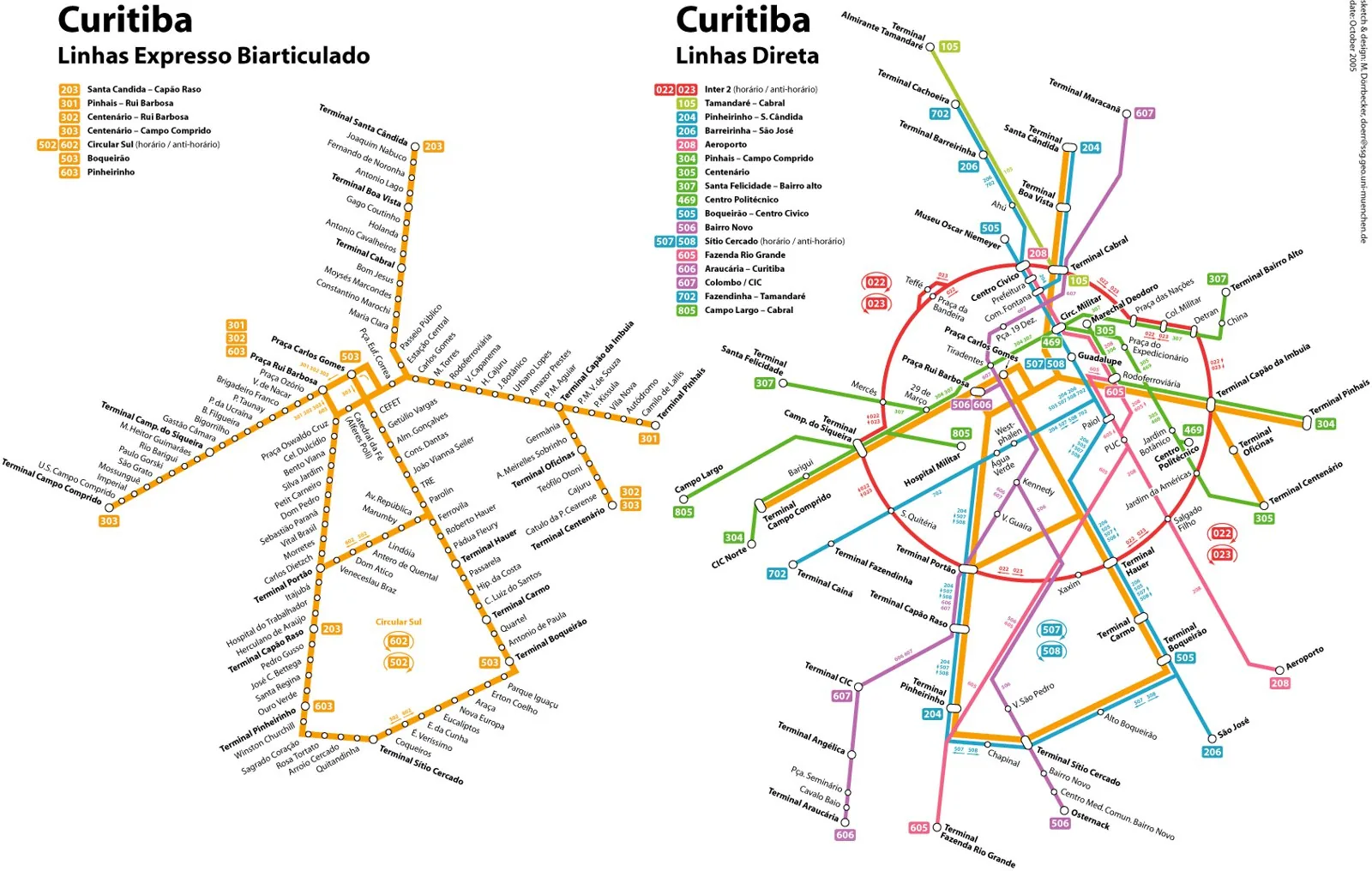
Linear axes, trinary roads, BRT backbone
Why it matters
Prototype of BRT-led urban structure
Description
Curitiba's 1966 Master Plan, driven by Jaime Lerner, channeled growth along structural axes served by a pioneering Bus Rapid Transit system, integrating land use, transit, and abundant parkland in a low-cost, transit-first model rather than relying on an expensive metro.
Significance
Curitiba became the global icon of affordable, transit-led urbanism, and its BRT invention was exported worldwide from Bogotá to dozens of cities. It proved that clever planning, not just big budgets, can transform a city.
What became of it
Sustained over six decades, the plan made Curitiba a global model for integrated transit-oriented planning and the world's first bus rapid transit system.
Critique
Rapid metropolitan growth pushed poorer residents to peripheral areas beyond the well-served structural axes.
What shaped it
- The master plan (early 20th c.)
- Garden Cities of To-Morrow (1898 / 1902)
- The linear park / greenway (1878 / 2009 revival)
- The Death and Life of Great American Cities (1961)
- The Image of the City (1960)
- The urban freeway (mid-20th c.)
Plans it influenced
- Groningen Traffic Circulation Plan (1977)
- Portland UGB + Metro 2040 (1979/1995)
- Seattle Urban Villages (1994/2016)
- Bogotá POT (2000/2021) (2000/2021)
- Medellín PUI & MetroCable (2004–)
- Los Angeles Mobility Plan 2035 (2015)
- Calgary Municipal Dev. Plan/CTP (2009/2020)
- Santa Cruz de la Sierra PLOT (2005)
Sources
- https://www.rtpi.org.uk/policy-and-research/futureproof-new-towns-international-lessons-on-how-t
- https://www.spatialagency.net/database/jaime.lerner