Washington, D.C.
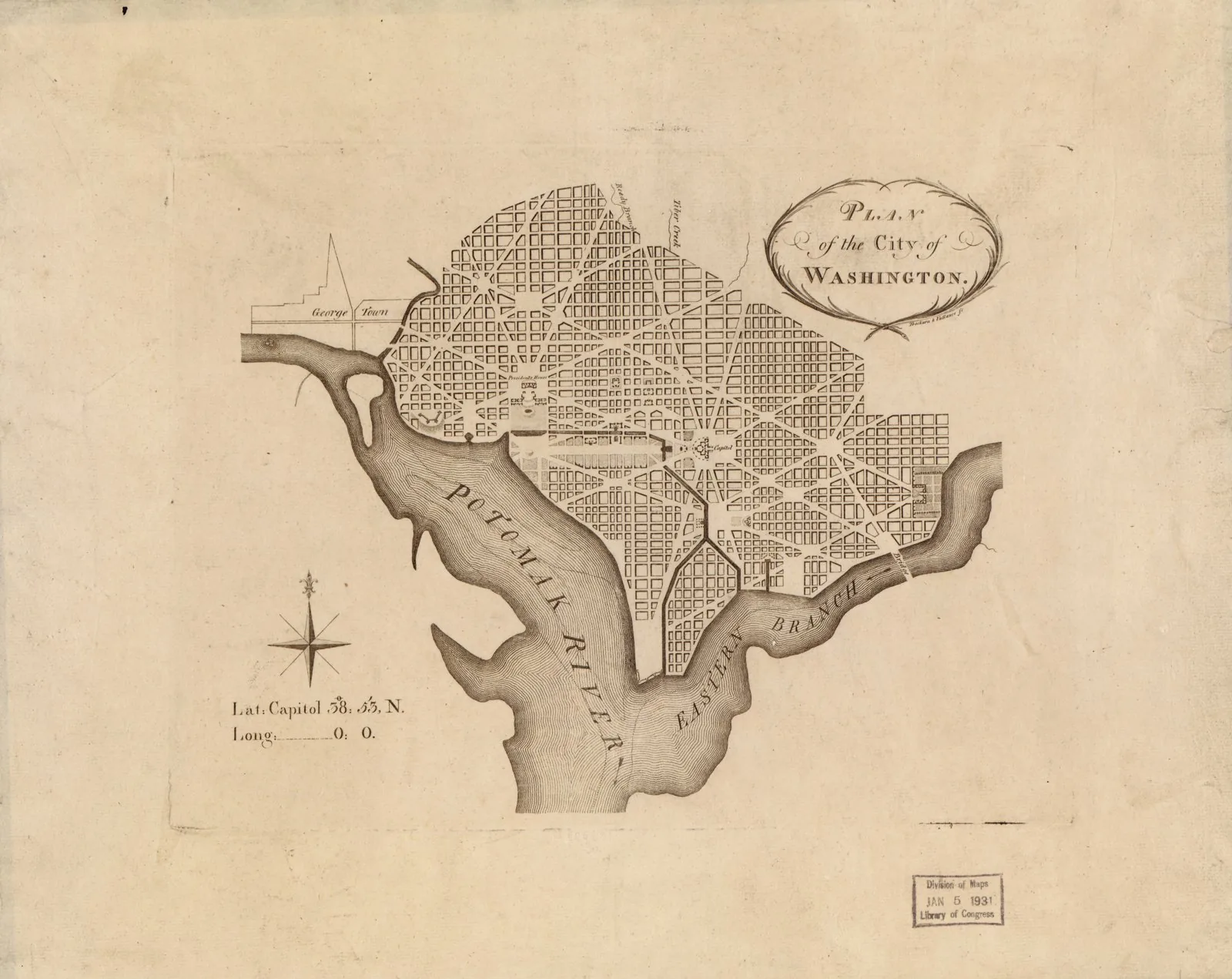
Core idea
Diagonal avenues over a grid; ceremonial nodes
Why it matters
Defines American federal capital form
Description
Pierre Charles L'Enfant's 1791 plan for Washington overlaid sweeping diagonal avenues — connecting monumental sites like the Capitol and the President's House — onto a gridded base, creating ceremonial vistas, circles, and a grand axis for the new republic's capital.
Significance
Washington fused Baroque monumental planning with the democratic symbolism of a new nation, translating royal axial grandeur into republican form. It is the great American example of the city designed to embody political ideals.
What became of it
L'Enfant was dismissed in 1792 and the plan executed in modified form; long neglected, it was substantially revived by the 1901-02 McMillan Plan and still structures central Washington's avenues, squares and vistas.
Critique
Critics argue the grandiose Baroque scale produced vast, underused diagonal intersections and awkward residual lots, and was wildly over-ambitious for the small population the new capital actually attracted.
What shaped it
- The American Revolution (1775–83 (declared 1776))
- The Enlightenment (18th c.)
- The United States Constitution (1787 (ratified 1788))
- De Architectura (c. 15 BCE)
- The grid (c. 2500 BCE)
Plans it influenced
- Abuja Master Plan (1979)
- NYC Commissioners’ Plan (Manhattan Grid) (1811)
- Washington DC Comprehensive Plan 2021 (2021)
- New Delhi (Lutyens’ Plan) (1911–1931)
- Athens (1833 plan) (1833)
- Canberra (1913)
- Detroit Woodward Plan (1807)
- McMillan Plan (Senate Park Commission), Washington, D.C. (1902)
Sources
- https://www.britannica.com/biography/Pierre-Charles-LEnfant
- https://en.wikipedia.org/wiki/L'Enfant_Plan