Wren’s Plan for London (unbuilt)
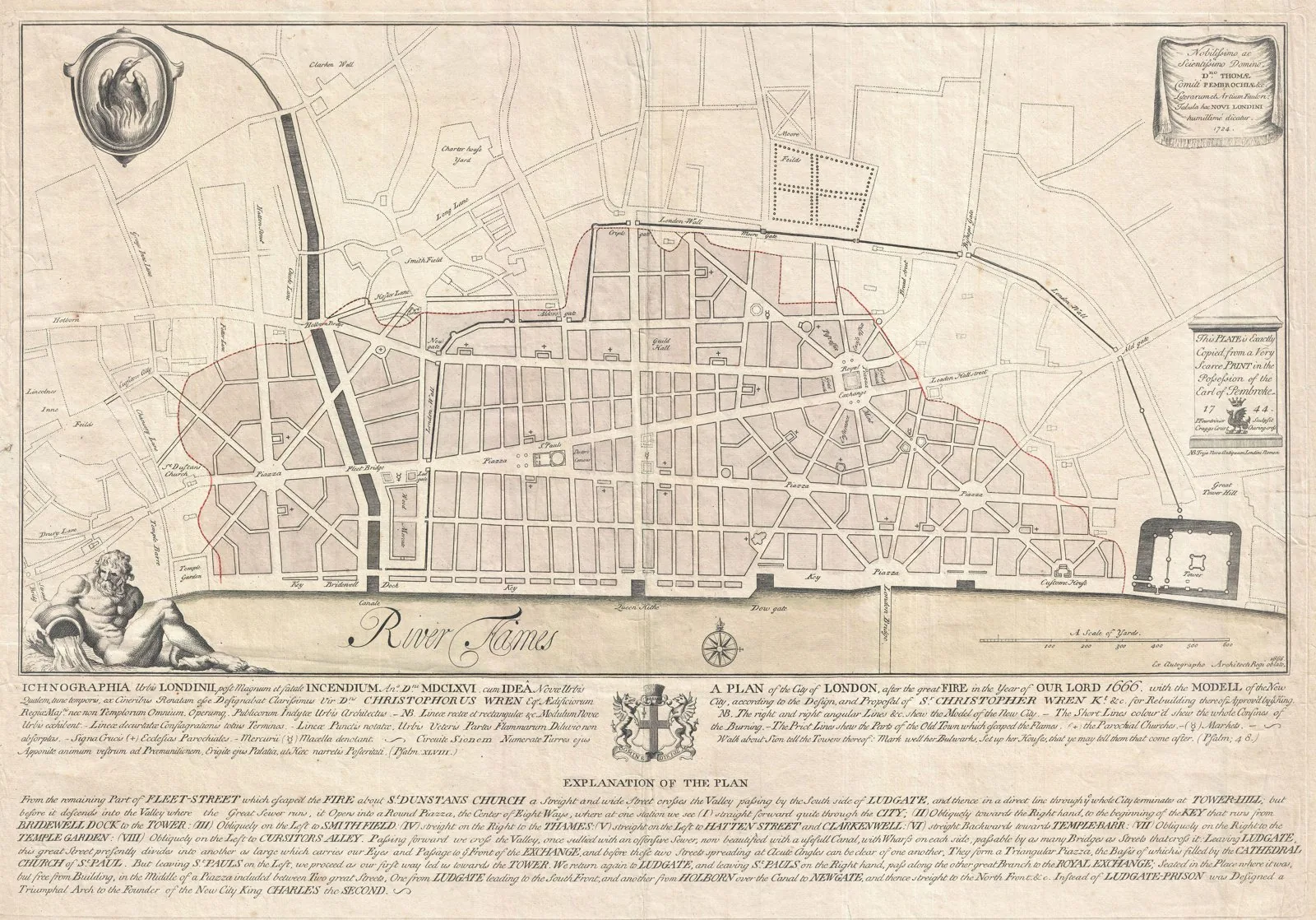
Core idea
Radial-baroque rebuild after the Great Fire
Why it matters
Ambitious but politically infeasible redesign
Description
Christopher Wren produced his plan for rebuilding London within days of the Great Fire of 1666. It proposed replacing the burnt medieval street pattern with a baroque composition of straight avenues radiating from plazas, focused on a rebuilt St Paul's and the Royal Exchange, with a broad quay along the Thames. The scheme required wholesale redistribution of property and was set aside as the city rebuilt rapidly on its existing plot lines.
Significance
Wren's plan is the great unbuilt project of English urbanism, demonstrating how property rights and the urgency of reconstruction can defeat even a favoured designer's comprehensive vision. It became a lasting reference in debates over replanning after disaster and was invoked by later movements, from the City Beautiful to post-Blitz reconstruction planning.
What shaped it
- Great Fire of London (1666)
- Plan for Rebuilding London (1666)
- Rebuilding of London Act (1667)
Plans it influenced
- Karlsruhe (1715)
- Lisbon Baixa Pombalina (1755–1777)
- Washington, D.C. (1791)
- Philadelphia Plan (1682)
- Detroit Woodward Plan (1807)
- Versailles — the planned royal town (the Trident) (1671)
Sources
- https://www.londonmuseum.org.uk/collections/v/object-466275/a-plan-of-the-city-of-london-after-t
- https://en.wikipedia.org/wiki/Christopher_Wren